
For Australian practices ringing every patient by hand
What every no show costs the practice, and which part of the reminding runs on its own.
A report on your own practice, showing what the empty appointments are costing you and which reminders never go out.
 By Reece Rainer
spareday, Newcastle NSW
Last updated
13 September 2026
Read time
8 minutes
By Reece Rainer
spareday, Newcastle NSW
Last updated
13 September 2026
Read time
8 minutes
A passion-driven, good-hearted and reliable service provider with the competency of a genius when it comes to software engineering, AI technology and marketing.
He was able to take our rough ideas, from concept through to reality. The site has provided an influx of new members, helping to keep our club viable.
Excellent in all facets of web design with particular expertise in SEO and email marketing. Online visibility has skyrocketed since working Reece which translates as flawless customer relations, new leads and new customers.
Somebody books three weeks out, forgets, and does not turn up. The chair sits empty for forty minutes while four people wait on a cancellation list nobody has time to ring. A new patient fills in the same form on paper in the waiting room that they could have filled in at home.
None of that touches clinical work. It is the administration around an appointment, and it is where most of a practice's wasted time and lost income sit. What follows is which parts of it run on their own, where it stops, and the order worth doing it in.
The reminder that stops a no show, the waitlist that fills a cancellation, the intake form a patient can do before they arrive, and the follow up after treatment that nobody has time to make.
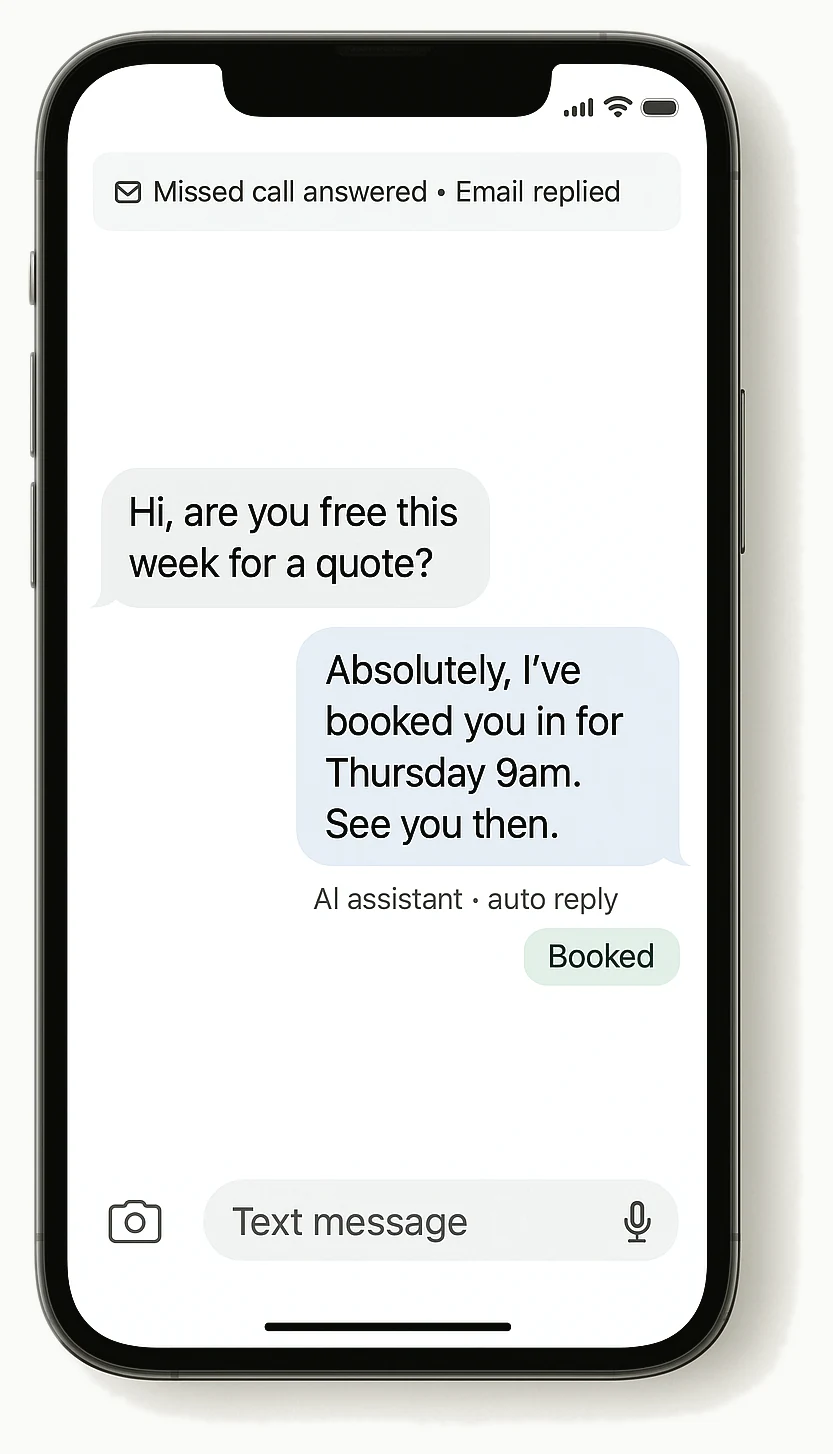
AI for healthcare, used this way, is appointment administration and nothing else. It never comes near clinical work.
Two different things get called AI, and only one of them matters here. The first is automation, which means a job that starts on its own: an appointment is a day away, so a reminder goes out. The second reads a patient's reply and answers in the practice's words, which is what turns a reminder into something people actually respond to.
All of that is work a practice already knows should happen. It happens when reception is quiet, instead of not at all in the weeks reception is not.
It costs the whole appointment. Clinical time that was booked and paid for in wages cannot be sold twice, and a no show is the only kind of lost income where the cost was already incurred.
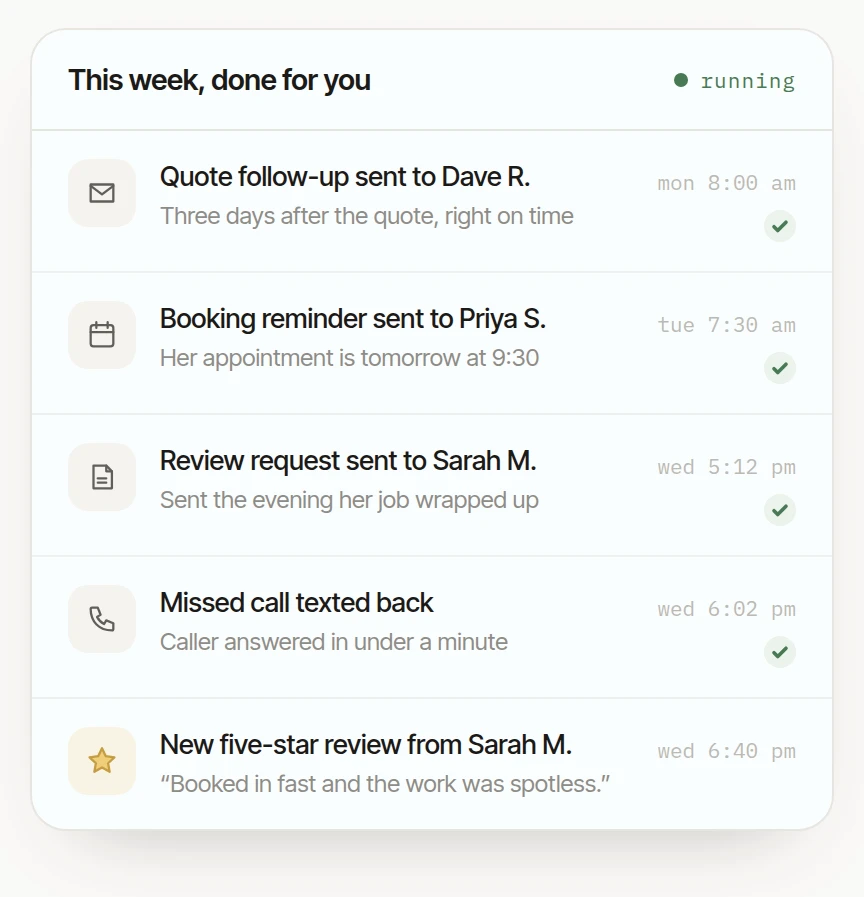
A no show is not a cancelled appointment. A cancellation with a day's notice can be filled from a waitlist. A no show is somebody who simply does not arrive, so the room, the chair and the person waiting in it are all paid for and none of it earns.
Most of them are not people changing their mind. They are people who booked three weeks ago and genuinely forgot, which is exactly the failure a reminder fixes.
Everything here sits inside the practice's obligations under the Privacy Act 1988, and health information carries the strictest handling of any category under it. That is a design constraint here rather than an afterthought.
Nothing here asks you to change practice management software. It works with what you already run, and the value is in the jobs happening around it rather than inside it.
Your practice software holds the appointments, the recalls and the patient records, and it does that properly. What it does not do is chase a patient, ring a waitlist or collect a form before the visit, which is why those land on reception.
Each of those takes a few minutes by hand. Across a full book they are most of reception's week. The audit maps them in your own software and puts a number beside each one before anything is built.
It touches nothing clinical. It gives no advice, it triages nobody, and it says nothing about a condition, a result or a treatment. It handles appointments and paperwork and stops there.
This line matters more here than anywhere else on this site. A confident wrong answer about a symptom is not an inconvenience, so the automation is built to be incapable of it rather than merely discouraged from it.
Where the work is genuinely administrative and written down, it runs. Where it is not, it stops and waits for a person, and every message it sent can be read afterwards.
The administration that only happens when reception is free goes on a list, and the job costing the most clinical time comes off it first. The wording gets approved before anything is built, and it runs watched before it runs alone.
The first one is the reminder, because an empty chair is the most expensive thing on the list. The next starts once that one is running.
Half a morning. What goes out, when, and what happens when a patient replies asking to move. Most practices have never had this written down anywhere.
A rough number goes beside each one. Reminders usually win outright, because every no show they prevent is a whole appointment recovered.
Every message goes out in the practice's name, so it gets written the way the practice writes and signed off before it exists as anything but words on a page.
Most practice management systems can already tell another system when an appointment is booked or cancelled. Nothing gets replaced and nothing gets migrated.
For a fortnight, with a person approving each message before it sends. That fortnight finds the patient situations nobody predicted, before a patient meets one.
A job is finished when nobody at reception is thinking about it any more. That is the signal to start the next one, rather than a date on a plan.
Writing down how the reminding actually happens takes longer than building it. The first job runs watched inside a fortnight, and the effect on the book shows up in the month after that.
Reminders show up in the book quickly, because a no show either happens or it does not. Recalls are the slower half, because they work on the practice's own cycle rather than on a calendar you choose.
Ask where patient information goes, what the automation is forbidden to say, whose accounts it runs in, and what you keep if you stop paying.
These are worth asking of anybody, including this one, so the answers given here sit under each question.
All of this can also be built in house, and plenty of practices do it well. The six steps above are the same either way.
If you do one thing after reading this, count the no shows in your book last month and multiply them by what an appointment is worth. That number is what a first call would ask for. Ask for the free report and it comes back with it.
Related reading from us: AI for small business and AI for accountants.
The reminder that stops a no show, the waitlist that fills a cancellation, the intake form a patient does at home, and the follow up after treatment.
No. It gives no advice, it triages nobody, and it says nothing about a condition, a result or a treatment. Anything clinical goes to a person every time.
It stays inside systems the practice controls and is not handed to a public AI tool, handled to the standard the Privacy Act sets for health information.
Most systems can already tell another system when an appointment is booked or cancelled, so it connects to what you run rather than replacing it.
They go out in the practice's words, because the practice writes and approves them first, and each one carries a way to change the appointment rather than just cancel.
Reminders, because a no show is the only lost income where the cost was already paid, and a reminder prevents most of them.
Yes. The slot goes to everybody on the waitlist at once and is filled by whoever answers first, which is the part reception rarely has time for.
One monthly fee covering everything, month to month, with no lock-in contract. What it comes to depends on the practice, so the number gets given on the call.