
For brokerages whose settlements never turn into reviews
The one week that works, and why replies stay free of detail.
A report on your brokerage, showing where you sit against the other brokers nearby on rating, count and recency.
 By Reece Rainer
spareday, Newcastle NSW
Last updated
13 September 2026
Read time
5 minutes
By Reece Rainer
spareday, Newcastle NSW
Last updated
13 September 2026
Read time
5 minutes
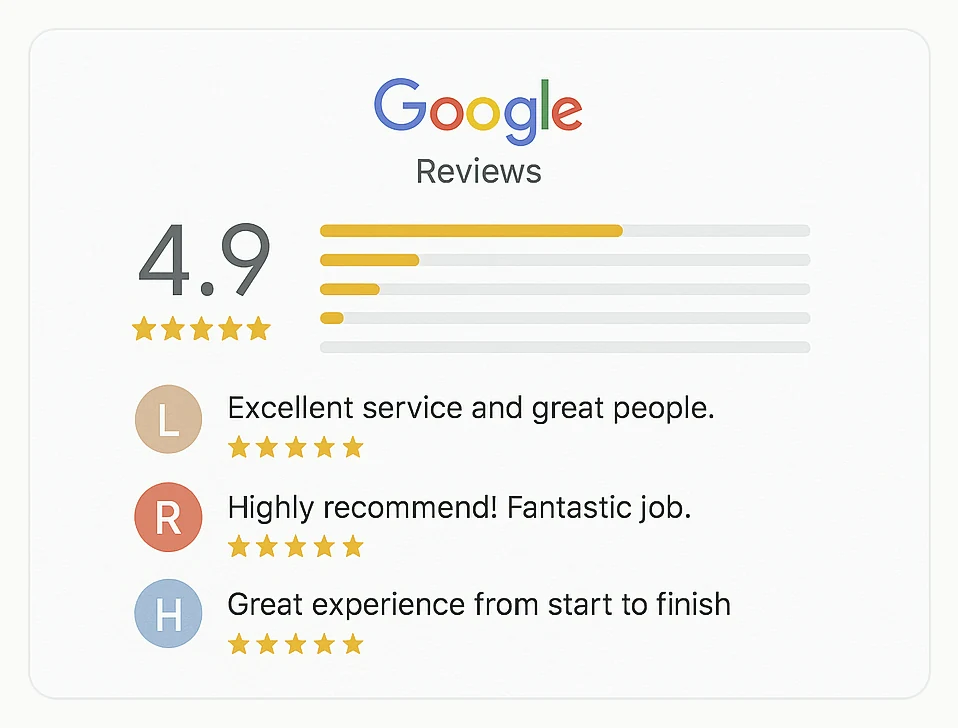
He was able to take our rough ideas, from concept through to reality. The site has provided an influx of new members, helping to keep our club viable.
A passion-driven, good-hearted and reliable service provider with the competency of a genius when it comes to software engineering, AI technology and marketing.
He created a stunning website for us that captures and nurtures leads with an automated email marketing system, which has filled a huge gap in the business and saved a lot of time (and money!).
A borrower is choosing who to hand their entire financial position to, and they are choosing between brokers who all look the same on a website.
This is why reviews carry so much of that decision, what a broker can and cannot have written about them, and the one week where asking works.
A borrower is deciding who to tell about their income, their debts and their spending, and then trust with the biggest commitment of their life. Nothing on a broker's website addresses that, and reviews are the only outside opinion available.
What they are reading for is quite specific and it is not expertise. They assume every broker knows the products. They are reading for whether this person explained things, whether they were still there when it got difficult, and whether anything was sprung on them.
The reviews that convert are the ones describing a problem. A borrower who reads that a valuation came in low and the broker sorted it has learned something no marketing sentence can tell them.
It also means first home buyers read reviews far more closely than refinancers, which is worth knowing because they are also the segment that generates reviews most willingly.
Ask in the week of settlement or approval. The client has just got the house, they are relieved and grateful in a way they will not be again, and the broker is the person they associate with it happening.
Miss that week and the sentiment decays quickly. Three months later they are dealing with a mortgage, not remembering a broker, and the good feeling has attached itself to the property instead.
The reason it gets missed is structural rather than lazy. Settlement week is the week the broker is busiest on that file and on four others, and the ask is the only task with no deadline attached to it, so it is the one that slides.
There is a second moment that works and is almost always skipped: an annual review that saved the client money. That one produces reviews from refinancers, who otherwise write almost none.
No incentive of any kind, no asking only the clients who went smoothly, and nothing in a review or a reply that reads as credit advice. A review saying a broker got somebody a specific rate is a problem for the broker, not for the client who wrote it.
The advice point is the one that catches people. A reply thanking a client and adding a line about what was achieved on their loan is a public statement about a credit product, and it is being made by a licensed party.
So replies stay warm and empty of substance. Thanks, glad it went well, no mention of rates, lenders, amounts or structures. That is not evasion, it is the same rule that governs everything else the brokerage publishes.
The incentive one shows up in a form specific to this industry: the referral thank you. Anything that gives a client value in exchange for a review breaches Google's policy, and referral arrangements have their own disclosure obligations on top.
A short message in settlement week, from the broker rather than from a system, with a link that opens the review box in one tap. Sent to every client at the same point in the file, not chosen case by case.
Tying it to the file rather than to somebody's memory is the entire trick. When the ask fires at the same milestone every time, it happens on the busy weeks too, which are the weeks it was always being lost.
It has to read like the broker. Clients have spent months in email with a specific person, and a message that suddenly sounds like a marketing department reads as though the relationship ended at settlement, which is the opposite of the point.
The link matters more here than in most industries because the client is on a phone, mid-move, with almost no patience. A message that requires them to find the business on Google converts a fraction as well.
If you do one thing after reading this, list your last ten settlements and check how many left a review. If it is under three, the ask is not happening at settlement week, and that is the entire gap.
Related reading from us: asked for inside the rules, Google reviews for gyms, AI For Mortgage Brokers, AI lead follow up for mortgage brokers and the enquiry that landed mid-appointment.
No. Any incentive breaches Google's policy and can cost you the reviews you already have.
No. A public reply naming rates, lenders or figures is commentary on a credit product made under your licence. Keep replies warm and free of detail.
Settlement week, or the week of unconditional approval. It is the high point of the client's regard for you and it does not come back.
They are not asked, and that is not gating. The ask is tied to a settlement milestone, so a file that did not settle never reaches it.