
For Australian retailers writing every post by hand
What an empty social feed and a silent customer list cost you, and which part of it runs on its own.
A report on your own shop, showing which customers never heard from you again, and what that is costing you.
 By Reece Rainer
spareday, Newcastle NSW
Last updated
13 September 2026
Read time
8 minutes
By Reece Rainer
spareday, Newcastle NSW
Last updated
13 September 2026
Read time
8 minutes
A passion-driven, good-hearted and reliable service provider with the competency of a genius when it comes to software engineering, AI technology and marketing.
He was able to take our rough ideas, from concept through to reality. The site has provided an influx of new members, helping to keep our club viable.
Excellent in all facets of web design with particular expertise in SEO and email marketing. Online visibility has skyrocketed since working Reece which translates as flawless customer relations, new leads and new customers.
The shop opens at nine and somebody is on the floor until five. The posting, the emailing and the writing all happen after that, or they do not happen at all, which is why most independent shops have a social feed that stops and starts.
None of that needs a decision from you. It needs somebody with a free hour, and in a shop run by two or three people nobody has one. What follows is which parts of it run on their own, what it will not do, and the order worth doing it in.
The posting nobody has time for, the email to customers who have not been in for months, the product descriptions for a new season, and the review nobody asks for.
AI for retailers is the marketing half happening on its own, and every word of it still gets read before it goes out.
Two different things get called AI, and only one of them matters here. The first is automation, which means a job that starts on its own: a customer has not bought in three months, so a message goes out. The second writes a first draft in your shop's words, which is what stops a post reading like it came from head office.
All of that is work a shop already knows should happen. It happens in the week the shop is busy, which is the same week it would have been worth the most.
It costs repeat customers. Somebody who bought from you once and then heard nothing for six months is somebody who now buys the same thing wherever they happen to be, and they were the cheapest sale you had.
An independent shop lives on people coming back. Getting somebody through the door the first time takes advertising or luck. Getting them back takes a reason and a reminder, and the reminder is the part that stops happening the moment the shop gets busy.
The same is true of the feed. A shop that posts for three weeks and then stops for two months is invisible in between, and the people who followed it were the ones most likely to come in.
The Australian Retailers Association has been saying for years that the independents holding their ground are the ones staying in front of their own customers, and this is the cheapest way to do that consistently.
Nothing here asks you to change systems. It works from your point of sale, your online store and your social accounts as they are, and the value is in the jobs happening around them.
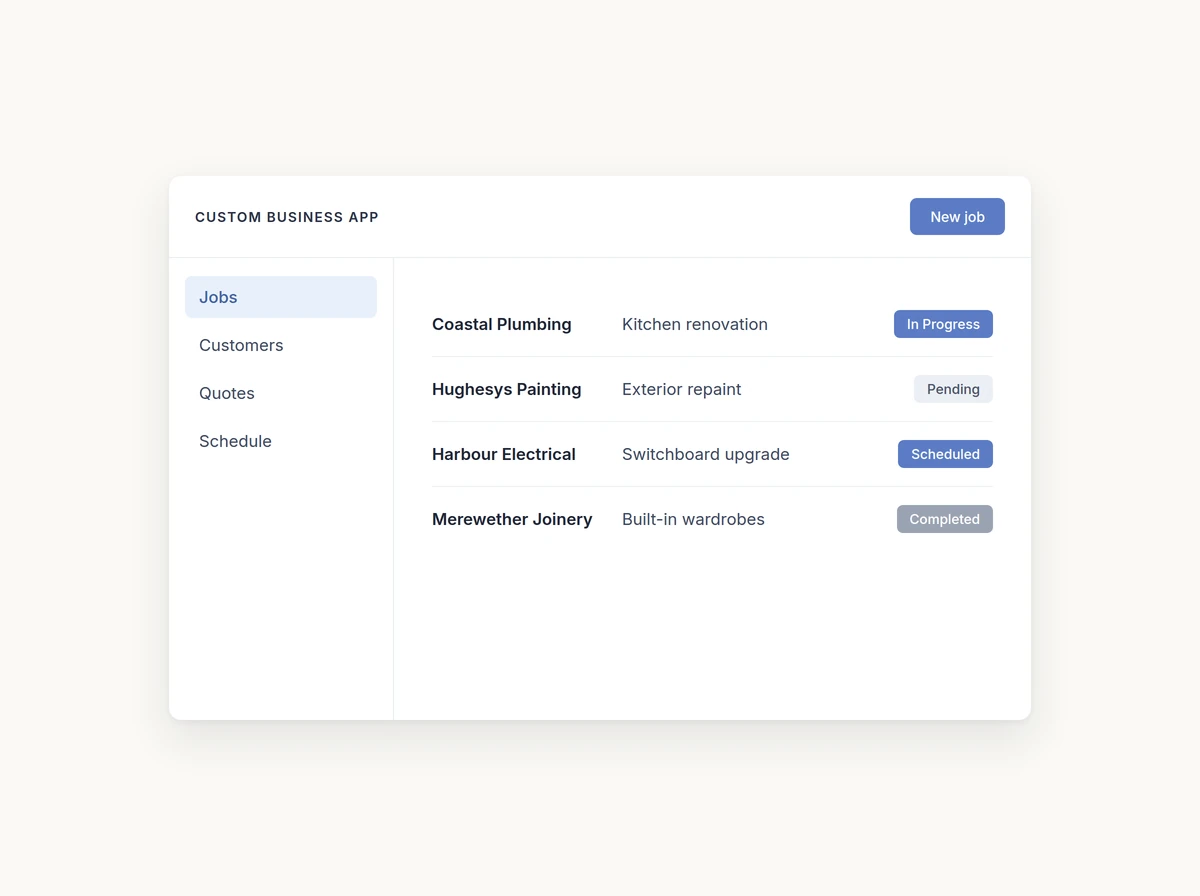
Your point of sale knows who bought what and when. Your store holds the products. Your social accounts hold the audience. What none of them does is write to those people, which is why that still happens after closing.
Each of those takes a few minutes by hand. Across a season they are the reason the marketing is the first thing dropped. The audit maps them in whatever you already run and puts a number beside each one.
It will not post without you reading it first, it will not price anything, and it will not say something about a product that is not in your own data.
A shop's voice is most of what people are buying, so nothing goes out unread. The drafts arrive in a batch and you change what does not sound like you before any of them are scheduled.
Where the job is genuinely repeatable and written down, it runs. Where it is not, it stops and waits, and everything it drafted can be read afterwards.
The jobs that only happen when somebody has a free hour go on a list, and the one costing the most repeat business comes off it first. The wording gets approved before anything is built, and it runs watched before it runs alone.
The first one is the message to lapsed customers, because those people already know you. The next starts once that one is running.
About twenty minutes. It is usually the posting, the email to the list, the descriptions and the review request.
A rough number goes beside each. Going back to people who already bought usually wins, because it costs nothing to reach them.
A handful of your own posts and emails, read properly, so the drafts come back sounding like the shop rather than like a brand.
For a fortnight, with somebody reading every draft. That fortnight is what stops the first month sounding generic.
Point of sale, store and social accounts stay exactly as they are. Nothing gets replaced and nothing gets migrated.
A job is finished when nobody in the shop is thinking about it any more. That is the signal to start the next one.
The voice takes longer to settle than the building. The first month of drafts arrives inside a fortnight, and it gets better through the first few rounds as the changes you make go back into it.
The customer messages start working sooner than the posting does, because those people already know the shop. The feed is the slower half and it works by accumulation.
Ask whose accounts everything runs in, who owns the customer list, whether anything goes out unread, and what you keep if you stop paying.
These are worth asking of anybody, including this one, so the answers given here sit under each question.
All of this can also be done in house, and plenty of shops do it well. The six steps above are the same either way.
If you do one thing after reading this, look at how many customers bought from you last year and have not been back. That number is what a first call would ask for. Ask for the free report and it comes back with it.
Related reading from us: AI For Small Business and AI For Healthcare.
The posting nobody has time for, the message to customers who have not been in, the product descriptions for a new season, and the review nobody asks for.
They are drafted from your own posts and photographs, and nothing goes out until somebody in the shop has read it and changed what does not sound right.
No. Every post and every email is a draft until somebody approves it. That is how it is built rather than a setting to switch on.
Yes, and with your point of sale. It connects to what you already run rather than replacing any of it.
It produces first drafts from your real details, in batches. Somebody still reads every one, and that is what sets the pace.
No. It never prices and it never discounts. What your shop says is what it says.
You do, in accounts in your own name. That gets settled in writing before anything is built.
One monthly fee covering everything, month to month, with no lock-in contract. What it comes to depends on the shop, so the number gets given on the call.