
For Australian online stores doing the admin by hand
What an abandoned cart and an unanswered question cost you, and which part of it runs on its own.
A report on your own store, showing where orders are being lost and which jobs only happen when somebody remembers.
 By Reece Rainer
spareday, Newcastle NSW
Last updated
13 September 2026
Read time
9 minutes
By Reece Rainer
spareday, Newcastle NSW
Last updated
13 September 2026
Read time
9 minutes
A passion-driven, good-hearted and reliable service provider with the competency of a genius when it comes to software engineering, AI technology and marketing.
He was able to take our rough ideas, from concept through to reality. The site has provided an influx of new members, helping to keep our club viable.
Excellent in all facets of web design with particular expertise in SEO and email marketing. Online visibility has skyrocketed since working Reece which translates as flawless customer relations, new leads and new customers.
Somebody puts three things in a cart on Tuesday night and does not check out. Somebody else asks whether an item will arrive before Friday and waits until Thursday for an answer. A new product goes up with the supplier's description on it because nobody had an hour to write one.
None of that needs a decision from you. It needs somebody to be there, and in a store run by one or two people nobody is there at ten at night. What follows is which parts of it run on their own, what it will not do, and the order worth doing it in.
The cart nobody came back to, the question asked before an order, the product description that has to be written for every new line, and the customer who bought once and never heard from you again.
AI for ecommerce is that work happening while nobody is at a desk, rather than anything that changes what your store sells.
Two different things get called AI, and only one of them matters here. The first is automation, which means a job that starts on its own: a cart sits untouched for an hour, so a message goes out. The second reads what a customer asked and answers in your store's words, which is what stops a reply reading like a template.
All of that is work a store already knows should happen. It happens at ten at night when the customer is deciding, instead of the next time somebody has a free afternoon.
They leak between the cart and the checkout, and between the question and the answer. Somebody who is ready to buy and gets no reply for a day is somebody who has already found the same thing somewhere else.
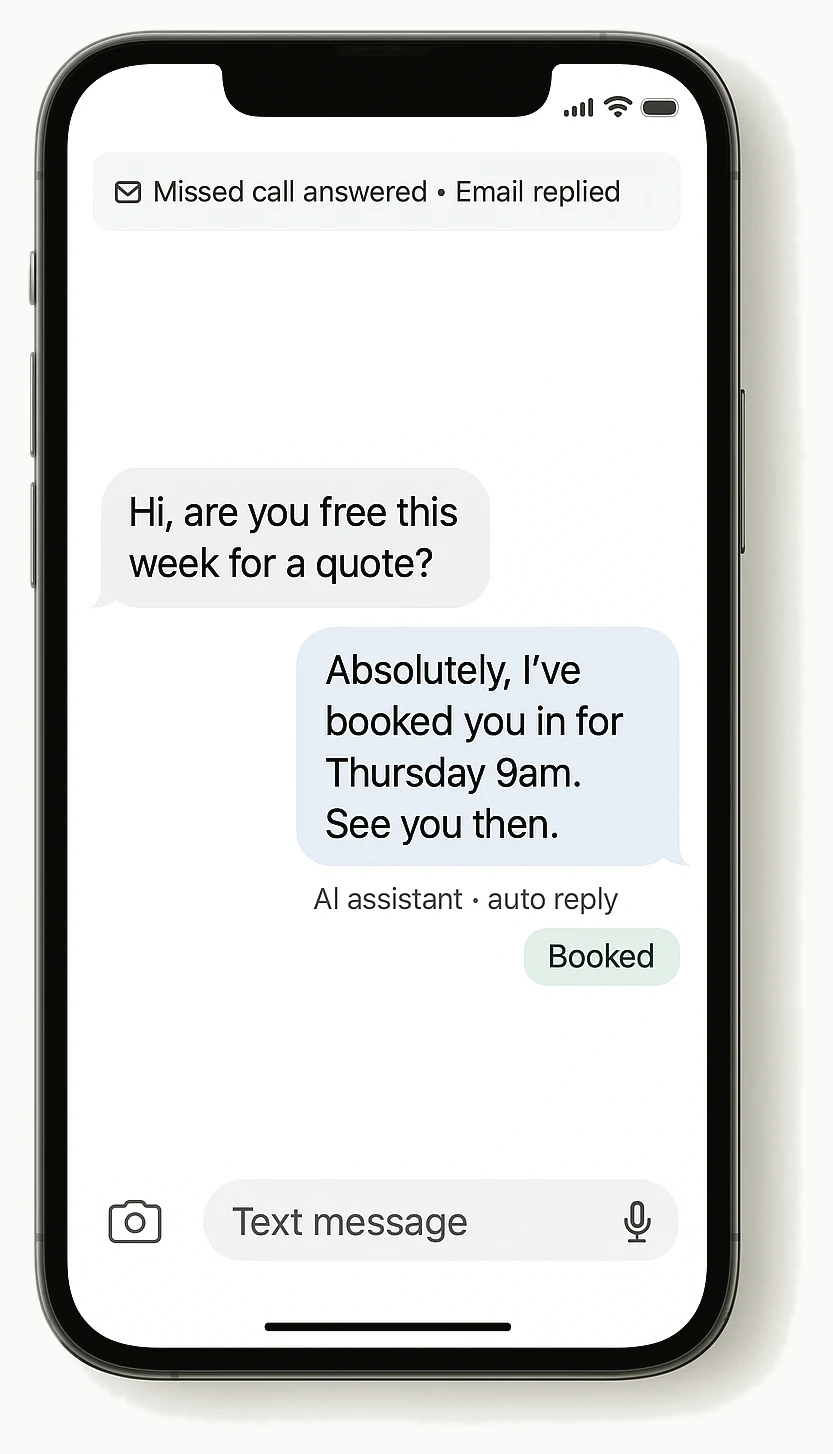
Watch what happens to a cart at ten at night. Three items in it, and one question in the buyer's head about whether it will arrive in time. Nobody is awake to answer, so they close the tab meaning to come back. Most of them do not.
The same thing happens on a slow reply. A store that answers a postage question inside a minute keeps the order. A store that answers it on Thursday is answering somebody who bought on Wednesday from a competitor who did.
The Australian Competition and Consumer Commission sets out what a store has to tell a buyer about delivery and returns, and answering those questions quickly is both the compliant thing and the thing that keeps the order.
Nothing here asks you to move platforms. It works on the store you already have, and the value is in the jobs happening around it rather than inside the platform itself.
Your platform holds the products, the orders and the customers, and it does that properly. What it does not do is write to a customer who left a cart, or answer a postage question at ten at night, which is why those still land on a person.
Each of those takes a few minutes by hand. Across a full catalogue and a week of orders they are most of the reason the evenings go. The audit maps them on your own platform and puts a number beside each before anything is built.
It will not price anything, it will not promise a delivery date it cannot see, and it will not tell a customer something about a product that is not in your own data.
The versions of this that go wrong all answer confidently with something untrue. A stock level it guessed, a delivery date it invented, a specification it made up. One of those becomes a complaint, and complaints about delivery and returns are the ones that carry consumer law behind them.
Where the job is genuinely repeatable and written down, it runs. Where it is not, it stops and waits, and every message it sent can be read afterwards.
The jobs that only happen when somebody remembers go on a list, and the one costing the most orders comes off it first. The wording gets written before anything is built, and it runs watched before it runs alone.
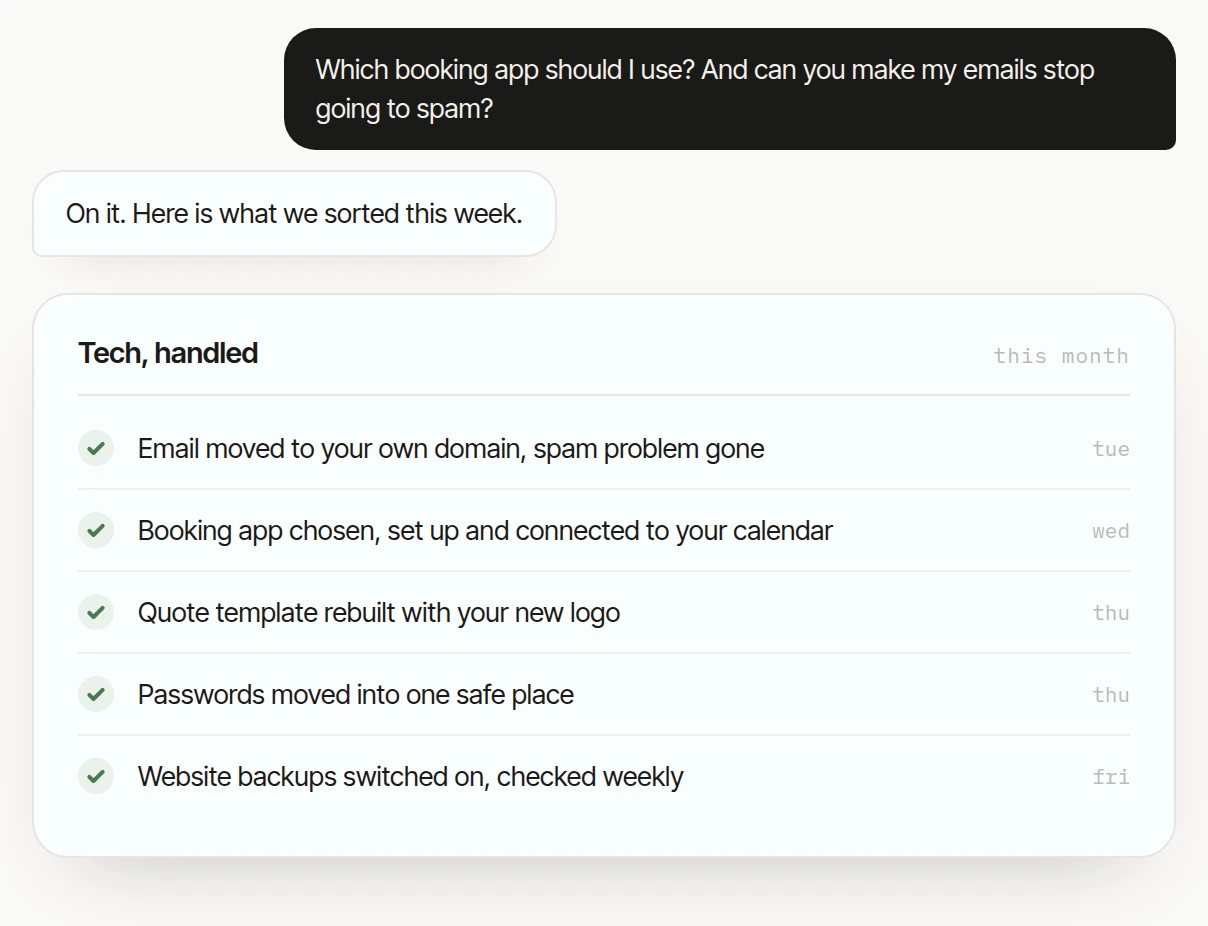
The first one is the abandoned cart, because it is the one with a ready buyer already on the other end. The next starts once that one is running.
About twenty minutes. It is usually the abandoned cart, the out of hours question, the product descriptions and the second order.
A rough number goes beside each. The abandoned cart usually wins, because those people were already through most of the deciding.
The words are what the customer sees, so they are the part worth getting right. Said the way you would say it to somebody standing in a shop.
For a week, with a person approving each message. That week finds the customers nobody predicted, before one of them meets it.
Every major store platform can already tell another system when a cart is abandoned or an order is placed. Nothing gets replaced and nothing gets migrated.
A job is finished when nobody is thinking about it any more. That is the signal to start the next one, rather than a date on a plan.
A single job takes about a week to build and a week to watch. Product descriptions run at whatever pace the catalogue allows, because every one of them still gets read before it goes live.

The descriptions are the long tail. They come back in batches as first drafts, and the reading and editing is what sets the pace rather than the writing.
Ask whose accounts it runs in, who owns the customer list, what it is forbidden to say about stock and delivery, and what you keep if you stop paying.
These are worth asking of anybody, including this one, so the answers given here sit under each question.
All of this can also be set up in house, and plenty of stores do it well. The six steps above are the same either way.
If you do one thing after reading this, look at how many carts were abandoned in your store last month and how many of those people ever heard from you. That number is what a first call would ask for. Ask for the free report and it comes back with it.
Related reading from us: the jobs that need remembering and the stock and the customers.
The cart nobody came back to, the question asked before an order, the product description for every new line, and the customer who bought once and never heard from you again.
They go out in your store's words, because you write and approve them first, and a cart message names what was actually in the cart.
Every major store platform can already tell another system when a cart is abandoned or an order is placed, so it connects to what you run rather than replacing it.
It produces a first draft from your real specifications and photographs. Somebody reads and edits every one before it goes live.
It answers from your own product and postage data or it does not answer. Anything it cannot see is handed to a person.
No. It never prices and it never discounts. What your store says is what it says.
You do, in accounts in your own name. That gets settled in writing before anything is built.
One monthly fee covering everything, month to month, with no lock-in contract. What it comes to depends on the store, so the number gets given on the call.