
spareday

For businesses advertising from one shopfront or one service area

Google Ads for a single location business: the settings that waste money, and the map to draw.

One location makes advertising easier and the default settings harder, because they are built for businesses that can serve anybody.

★★★★★Newcastle and the Hunter

A report on your own business, showing what people nearby search for and which businesses currently answer it.

Reece Rainer By Reece Rainer spareday, Newcastle NSW Last updated 13 September 2026 Read time 2 minutes
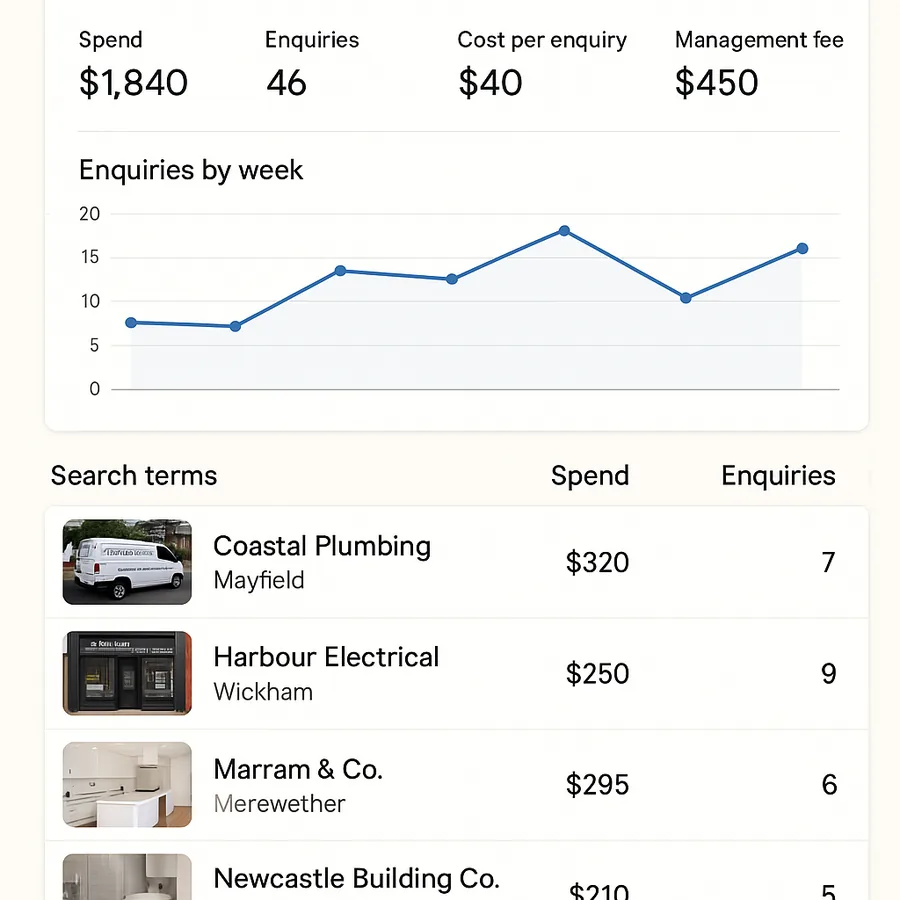
A monthly ads summary showing the spend, the enquiries, the cost per enquiry and the management fee as four separate figures
what clients say

What clients say

★★★★★

Since it went live my phone hasn’t stopped ringing.

Jye Hughesgoogle review
★★★★★

He created a stunning website for us that captures and nurtures leads with an automated email marketing system, which has filled a huge gap in the business and saved a lot of time (and money!).

Gene Kellygoogle review
★★★★★

Reece has been generous, reliable and knowledgeable in creating an online presence for our sporting club. He is good to work with and has good technical abilities.

Gary Robertsgoogle review

See them all on Google

A business with one location is advertising to a small map, and the default settings in a new account are built for one that is not.

Most of the money wasted in a local account goes to people who were never going to travel that far.

01

The settings that waste the budget

Four: who counts as being in the area, how wide the area is, which partner sites the advertisements appear on, and whether close variants of the phrase are allowed.

Each of these is on by default in a new account, and each one widens the audience past what one location can serve.

The four

  • Presence, or interest.

    The default includes people merely interested in the area. Change it to people actually in it.
  • The radius.

    A shopfront and a service business need different maps. Both are smaller than the default.
  • Partner sites.

    Advertisements shown across other websites rarely suit a local service and spend the budget fast.
  • Loose matching.

    Google widens a phrase on its own, so the searches actually paid for have to be read each week.
Get my free reportA report on your own business, showing what people nearby search for and which businesses currently answer it.
02

What a tighter map changes

Fewer clicks for the same money, and a higher share of them from people who can reach the business. The total falls and the enquiries usually do not.

A click from ninety minutes away costs the same as a click from the next suburb and is worth much less.

Where to draw it

  • A shopfront.

    How far a customer will genuinely drive, which for most retail is fifteen minutes.
  • A service business.

    The suburbs the business will actually travel to without adding a call-out charge.
  • A clinic or a studio.

    Usually tighter again, because people book near home or near work.
  • Anything after hours.

    A call that arrives at night needs somebody to answer it, or the click is wasted.
Get my free reportA report on your own business, showing what people nearby search for and which businesses currently answer it.
03

How to judge the result

Count calls, form enquiries and visits to the shop, not clicks. A single location account is small enough that every enquiry can be traced.

At local volumes the numbers are small, so a month is the shortest period worth reading.

The four numbers

  • Enquiries, not clicks.

    Which needs tracking set up properly before the first dollar is spent.
  • Cost per enquiry.

    The only figure that can be set beside the value of one job.
  • Where they came from.

    Suburb by suburb, which says whether the map is drawn correctly.
  • What was searched.

    The actual phrases paid for, read weekly, because they drift.
Get my free reportA report on your own business, showing what people nearby search for and which businesses currently answer it.

Related reading from us: marketing agency services.

Common questions

How wide should the advertising area be?

As wide as a customer will genuinely travel. For most shopfronts that is about fifteen minutes, and for service work it is the suburbs already served.

Why does the budget disappear so quickly?

Usually the area includes people only interested in the suburb rather than in it, and the partner sites are still switched on.

Is Google Ads worth it for one location?

It is, when one job earns more than the enquiries it takes to win it. That arithmetic decides it.

How long before it is worth judging?

A month. Local volumes are small, and a week of data on a single location account says very little either way.

What does it cost?

One monthly fee covering everything, month to month, no lock-in. The number depends on the business and gets given on the call.

What else we do

See what your area actually searches for
before you spend a dollar on it

Call 0485 017 387
×

Get my free report

See exactly where you rank in every suburb you serve. Takes 60 seconds.

Or send a longer enquiry