
For businesses whose best jobs ring after five
The calls that come in after five are the urgent ones, and an unanswered one rings the next business on the list.
A report on your own number, showing what a caller gets after hours and where the enquiries are going instead.
 By Reece Rainer
spareday, Newcastle NSW
Last updated
13 September 2026
Read time
3 minutes
By Reece Rainer
spareday, Newcastle NSW
Last updated
13 September 2026
Read time
3 minutes
Since it went live my phone hasn’t stopped ringing.
He created a stunning website for us that captures and nurtures leads with an automated email marketing system, which has filled a huge gap in the business and saved a lot of time (and money!).
Reece has been generous, reliable and knowledgeable in creating an online presence for our sporting club. He is good to work with and has good technical abilities.
After hours phone answering services exist because of one habit: somebody with an urgent problem rings the first number, and if nobody picks up they ring the second one.
They rarely ring back. The call is not lost because the caller changed their mind, it is lost because somebody else answered first.
It goes to the next business on the search results, and the caller almost never comes back, because by then their problem is being handled.
Voicemail does not hold the caller. Most people hang up on it, and the ones who leave a message have usually rung somebody else in the same minute.
The evening calls are also the expensive ones. A burst pipe, a lockout, a dead hot water system and a booking for tomorrow are all urgent, and urgent callers ask about price last.
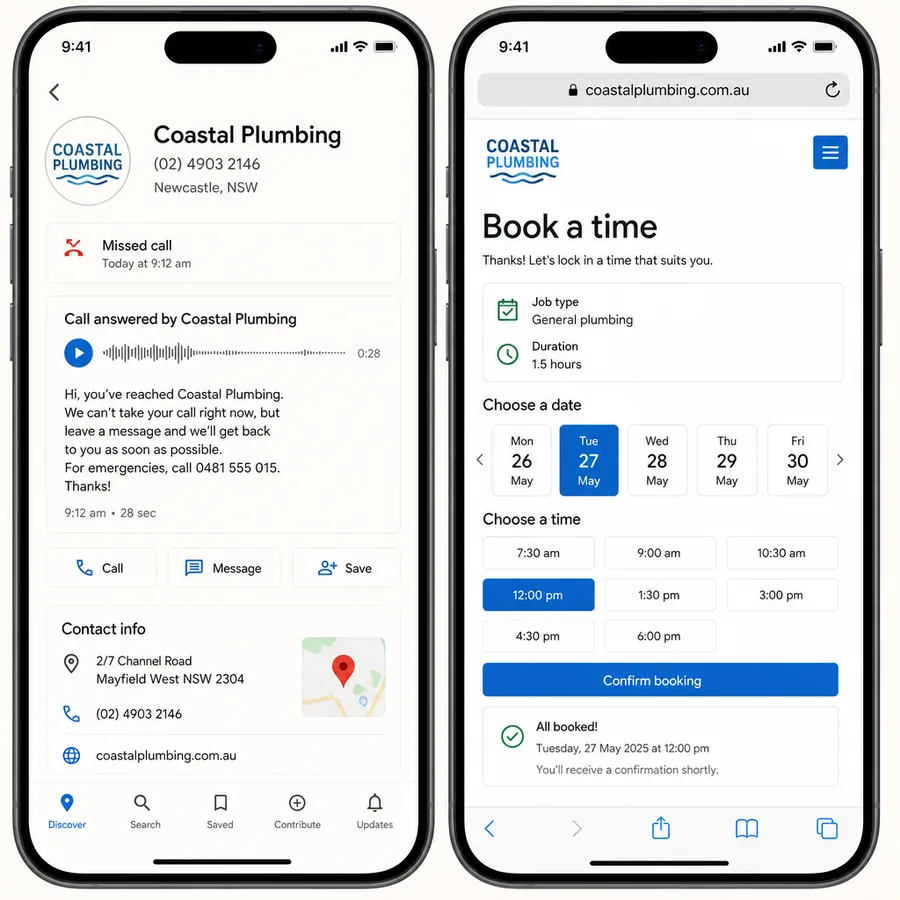
A human answering service, an automated one that takes the call, or a text that goes back the moment a call is missed. Each one suits a different kind of business.
A human service puts a real person on the phone, usually charged per call or per minute. It reads well to a caller and the cost moves with how busy the month is.
An automated service answers every call at once, takes the name, the address and what is wrong, and sends it through. It never queues, and it holds the same script at two in the morning as at ten.
A text back is the smallest version. The caller gets a message within seconds saying you are on a job and asking what they need, and plenty of people reply to a text they would not leave a voicemail on.
Four decisions turn an answering service from a message-taker into something that actually books work, and they get made before it goes live rather than after.
The first is what counts as after hours. A trade that gets its best work at seven at night wants a different line drawn to a clinic that closes at five and means it.
The business that answers at seven at night has decided in advance what happens to that call. Everything else about it is the same, including the hours the owner works.
Related reading from us: AI receptionist for tradies.
Yes. Calls to your existing number divert when they are not answered, so nothing on your signage, your listing or your vehicle has to change.
They can tell it is a service rather than you, the same way they can with a human one. What holds them is being answered and being asked the right questions.
A text goes back to the number that rang. That catches the callers who will not talk to anything but will happily type.
It can, where the diary allows it. Plenty of businesses start with taking details and add booking once they trust what it writes down.
One monthly fee covering everything, month to month, with no lock-in contract. What it comes to depends on the business, so the number gets given on the call.