
For fencing contractors missing quote requests
What it does, what it will not do, and how to tell if you need it.
A report on your own number, showing how many quote requests rang out last month and when they arrived.
 By Reece Rainer
spareday, Newcastle NSW
Last updated
13 September 2026
Read time
3 minutes
By Reece Rainer
spareday, Newcastle NSW
Last updated
13 September 2026
Read time
3 minutes
He was able to take our rough ideas, from concept through to reality. The site has provided an influx of new members, helping to keep our club viable.
A passion-driven, good-hearted and reliable service provider with the competency of a genius when it comes to software engineering, AI technology and marketing.
He created a stunning website for us that captures and nurtures leads with an automated email marketing system, which has filled a huge gap in the business and saved a lot of time (and money!).
Every fencing enquiry is a site visit and a real job, which makes an unanswered one different from a missed call in a trade that also fields time-wasters.
This is what a text-back does about the calls that ring out, and why the quoting cycle makes speed matter more here than most people expect.
Fencing is priced by the metre after somebody has looked at the site, so nearly every enquiry is a genuine job rather than a question. There is very little noise in a fencing phone line.
That is unusual. Plenty of trades field calls that turn out to be nothing, so a missed one is a coin toss. A fencing enquiry is somebody who has decided they want a fence and is now choosing who measures it.
The other side of it is that the customer is collecting quotes rather than booking. They will speak to three businesses, and the sequence in which they do that shapes the outcome more than most contractors realise.
Meanwhile you are on a site with a post driver running, which is not a place anybody takes a phone call.
The first quote becomes the reference point. Whoever measures first sets the scope and the price the other two are compared against, and that is a real advantage.
A customer with no quotes has no idea what a fence costs. The first contractor to walk the boundary explains the options, the materials and why it costs what it does, and everything afterwards is judged against that explanation.
Arriving third is a weaker position even with a better price, because by then the customer has a fixed idea of the job and is asking you to price somebody else's version of it.
Being first is largely a function of who replies first, which is a function of what happens when your phone rings out.
In clusters. After storms, at the start of the warmer months, and after a neighbour has a fence done, and almost never spread evenly.
Storm weeks are the extreme version. Half a suburb needs the same work at once, everybody rings everybody, and the contractors who answer take the season.
The clustering also means the quiet-month call log understates the problem. Judge it on the busiest month you have had, not on this one.
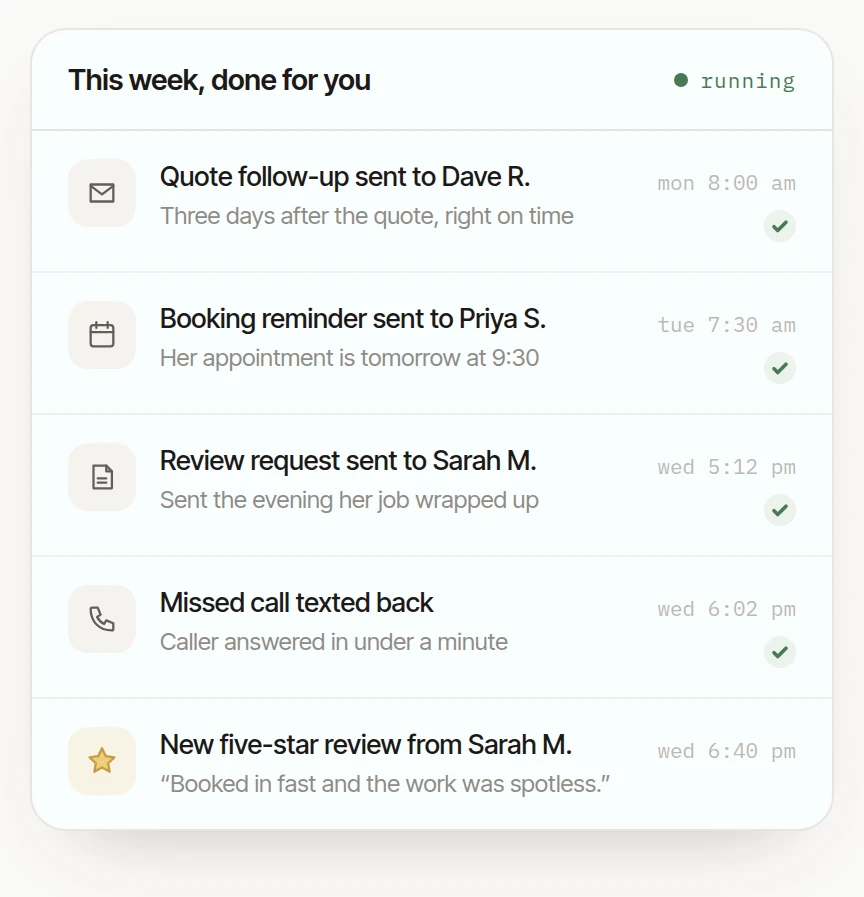
A call that rings out triggers a text within seconds saying you are on a job and asking where the fence is and roughly how long, so you can plan quoting runs rather than lose the enquiry.
The practical benefit for fencing is the batching. Knowing the addresses means you can quote four jobs in one afternoon in one part of town instead of driving across the city for each one.
It quotes nothing. Fencing cannot be priced without a look, and anything that implies otherwise creates an argument later.
In fencing nearly every call is a job and the first quote sets the price. Both of those make an unanswered call more expensive than it looks.
Related reading from us: Missed Call Text Back For Tradies, Missed Call Text Back For Pest Control, Google Reviews For Fencing Contractors and local SEO for fencing contractors.
A short text within seconds in your own words, asking where the fence is and roughly how much is needed.
No, and it should not. Fencing is priced after a look, and a number given blind causes a problem at the quote.
A text cannot reach a landline, so those alert you directly instead.
Judge it on a storm week rather than a quiet month. That is when the calls and the losses actually happen.