
For fencers being compared to two other numbers
Always one of three quotes, and a second customer nobody asks.
A report on your business, showing where you sit against the other fencing businesses nearby on rating, count and recency.
 By Reece Rainer
spareday, Newcastle NSW
Last updated
13 September 2026
Read time
5 minutes
By Reece Rainer
spareday, Newcastle NSW
Last updated
13 September 2026
Read time
5 minutes
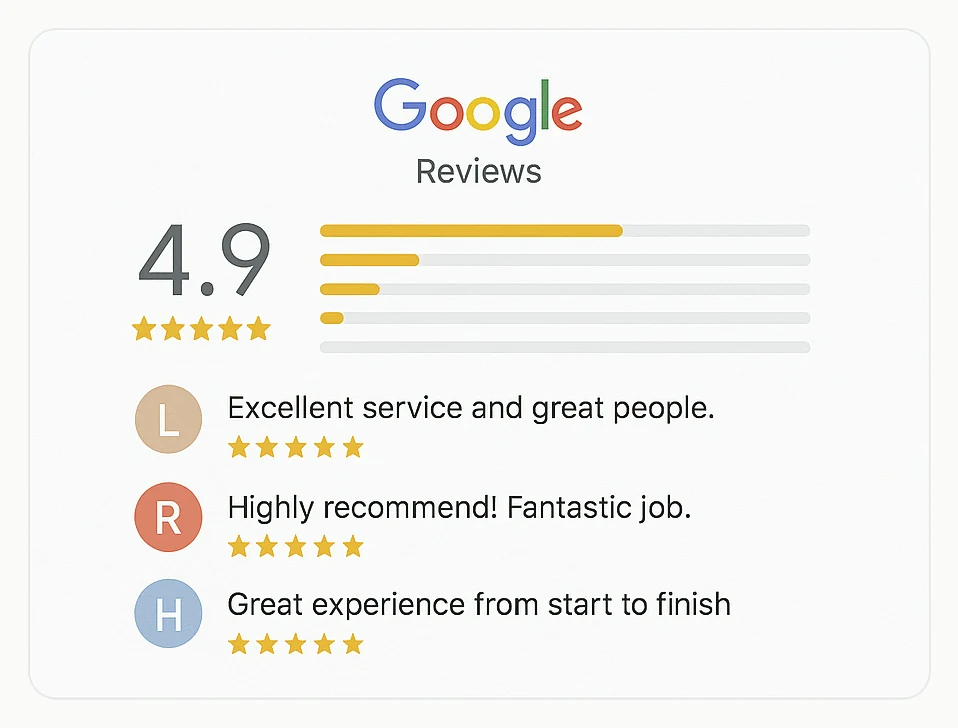
He was able to take our rough ideas, from concept through to reality. The site has provided an influx of new members, helping to keep our club viable.
A passion-driven, good-hearted and reliable service provider with the competency of a genius when it comes to software engineering, AI technology and marketing.
He created a stunning website for us that captures and nurtures leads with an automated email marketing system, which has filled a huge gap in the business and saved a lot of time (and money!).
Almost nobody gets one fencing quote. They get three, and then they spend an evening working out which of the three to believe.
This is what decides that comparison, why a fence has two customers and one invoice, and how a fencing business gets reviews out of a job that finishes in a day.
Fencing is priced by the metre after a look, so a customer collects three numbers that are usually close together. The price does not separate anybody, which means the decision falls to whatever else is available, and that is the reviews.
This is a different competitive position to most trades. A plumber with a blocked drain is usually the only plumber the customer speaks to. A fencer is one of three, side by side, being read about on a phone at the kitchen table.
What separates the three is almost never the fence. It is who turned up to quote when they said, who sent the quote through afterwards rather than promising to, and whose reviews say they did what they said.
The middle quote wins more often than the cheapest, and reviews are the reason. Customers are wary of the lowest number and are looking for a justification to pay a bit more, which is exactly what a review page provides.
Half of what a fencing customer will eventually write about happens during the quoting, and most fencing businesses do not realise it. Arriving when you said and sending the quote the same evening is the thing customers describe.
The reason is that they have just been let down twice. The industry standard for quoting is not turning up, or turning up and never sending anything, and every customer collecting three quotes has experienced it that week.
So being ordinary and reliable at the quote stage is a genuine advantage, and it is what the reviews say. Read any good fencing business's profile and it is full of people describing basic professionalism as though it were remarkable, because to them it was.
This also means the ask can reference it. A customer who was impressed before the work started has more to say than one who is only reporting that a fence exists.
A boundary fence is shared, and in most states the cost is too. That means two households are watching the job, both of them can review it, and the one who is not paying often has the stronger opinion about how it went.
Nobody in fencing treats the neighbour as a customer, and they are the most under-used source of reviews and referrals in the trade. They watched the whole job from their side, and they now need their other three boundaries done eventually.
The neighbour is also where the complaints come from. Disputes about the line, about access, about a gate, about who agreed to what. A fencing business that handles the neighbour well is preventing its own worst reviews.
Asking them is straightforward and almost nobody does it. They were part of the job, they saw it done properly, and a review from the household next door reads as unusually credible because they had nothing to gain.
A short message the afternoon the job finishes, from the business, with a link that opens the review box in one tap, sent to every customer and offered to the neighbour on the day.

Same day matters in this trade because a fence is a one-day or two-day job with a visible result. The customer comes home, the fence is up, the site is clean, and that is the peak of their opinion of you.
It fades faster than most trades too. A fence becomes invisible within a fortnight. Nobody looks at a fence they own, so a request two weeks later reaches somebody with nothing to say.
Photographs are worth asking for here specifically. A fence is photogenic in a way a switchboard is not, and a review with a picture of a finished job is the closest thing a fencing business has to a portfolio that a stranger trusts.
If you do one thing after reading this, ring the last neighbour whose fence you replaced and ask if they would put a line on Google. Nobody in the trade does this and it works almost every time.
Related reading from us: Google Reviews For Tradies, a year of enquiries in six weeks, Local SEO For Fencing Contractors and missed call text back for fencing contractors.
No. Any incentive is against Google's policy and can cost you the reviews you already have.
Where the fence is shared, and usually cost-shared, they are as much a customer as the person who rang you. Ask on the day, in person, and it is rarely refused.
The afternoon the job finishes. A fence stops being interesting to its owner within about a fortnight.
Reply once, briefly, without taking a side in public, and offer to speak. Boundary disputes are common and readers understand them when the reply is calm.