
For firms whose review page describes a third of the practice
What a client can actually judge, and the clients who will never write one.
A report on your firm, showing where you sit against the other practices nearby on rating, count and recency.
 By Reece Rainer
spareday, Newcastle NSW
Last updated
13 September 2026
Read time
5 minutes
By Reece Rainer
spareday, Newcastle NSW
Last updated
13 September 2026
Read time
5 minutes
He was able to take our rough ideas, from concept through to reality. The site has provided an influx of new members, helping to keep our club viable.
A passion-driven, good-hearted and reliable service provider with the competency of a genius when it comes to software engineering, AI technology and marketing.
He created a stunning website for us that captures and nurtures leads with an automated email marketing system, which has filled a huge gap in the business and saved a lot of time (and money!).
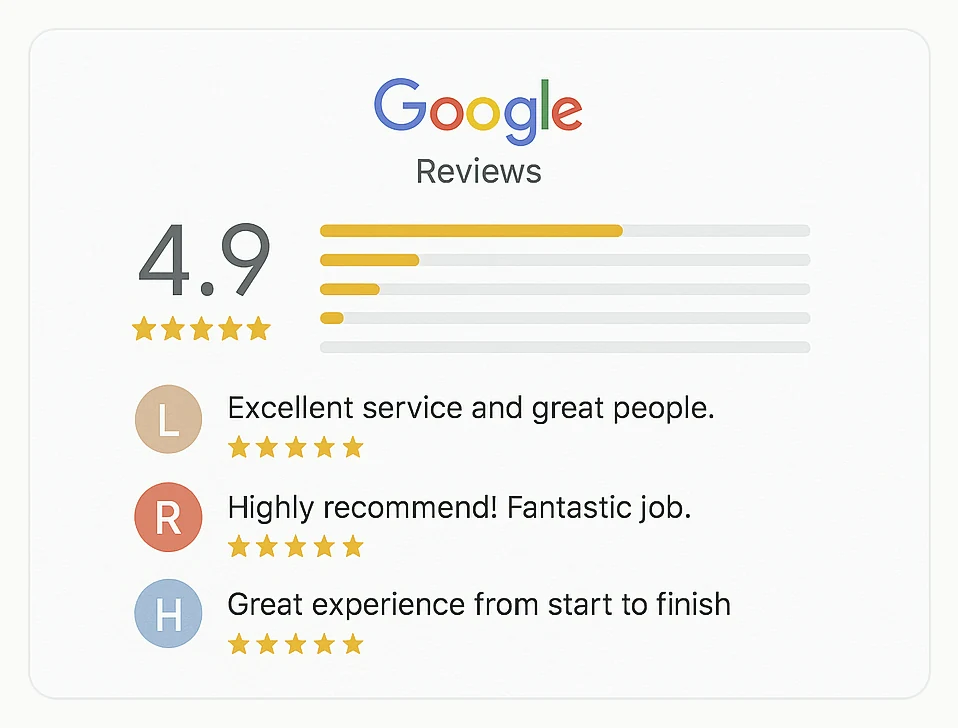
A person choosing a solicitor has almost nothing to go on. They cannot judge the drafting, they do not know anybody who will admit to needing a lawyer, and so they read what strangers wrote.
This is why reviews decide more for a law firm than for most businesses, the restrictions a firm is actually working under, and how a practice asks without creating a problem.
A client cannot tell a good settlement from one that left money on the table, and they will never see the alternative. So they judge what they can observe, which is whether they were kept informed, whether the bill matched what they were told, and whether they were treated like a person.
That is what the reviews of every firm are actually about, and reading a few makes it obvious. Almost none of them mention the law. They mention being rung back, having something explained twice without irritation, and knowing what it would cost.
It means a technically excellent firm with bad communication reviews badly, and there is no arguing with it, because the client is reporting the only thing they were in a position to observe.
It also means the reviews a firm already has are a fairly accurate report on its client service, which is uncomfortable and useful in equal measure.
A person who has just been through a divorce, a criminal matter or a dispute with a former employer is not going to attach their name to a public account of it. That is not reluctance, it is sense, and no amount of asking will change it.
This shapes a law firm's review profile in a way most advice ignores. Family, criminal and employment work produces excellent outcomes and almost no reviews, while conveyancing and wills produce reviews easily, because there is nothing private about buying a house.
The practical effect is that a mixed practice ends up with a review page describing a third of what it does. That is worth knowing before anybody concludes the firm is bad at asking.
It also means the asking has to be selective in a way that is about discretion rather than about filtering for happy clients, and the difference between those two things matters.
Solicitors advertise under professional conduct rules as well as Google's policy. A review cannot be paid for or incentivised, a firm cannot write or edit one, and nothing in a firm's response can disclose anything about a client's matter, even to correct something false.
The response is where firms get into trouble, and it happens for an understandable reason. A former client writes something inaccurate about a matter, and the instinct of somebody who knows the file is to correct the record.
Doing that discloses information about a client's matter in public. The obligation survives the retainer and it survives the client being wrong. The reply says the firm cannot discuss a client's matter publicly and offers to speak directly, and it says nothing else.
The other one is the incentive, usually dressed up as a thank you rather than a discount. It breaches Google's policy either way and it can take the whole review page down with it months later.
The ask goes out when a matter closes cleanly, from the firm, in writing, with a link that opens the review box directly. Which matter types are eligible is decided once by the firm rather than case by case.
Deciding it once is what makes it workable. A rule that says every settled conveyance and every completed estate plan gets the ask, and nothing in family or criminal does, removes the judgement call from a busy week where it would simply be skipped.
Timing matters more than firms expect. The week a purchase settles is the high point of a client's regard for their solicitor; two months later they have moved house and the whole thing has become admin they have forgotten.
The wording has to sound like the firm. A message that reads like marketing sits badly under a solicitor's name and clients notice it immediately, so this is one of the few places where a slightly formal tone converts better.
If you do one thing after reading this, look at the date of your firm's most recent Google review. If it is older than a couple of months, the firm is not asking, and the clients who would have written one have moved on.
Related reading from us: Google reviews for dentists, Google Reviews For Mortgage Brokers, AI For Lawyers, AI receptionist for lawyers and the call nobody leaves a message on.
No. Any incentive, including a donation or a discount, breaches Google's policy and puts the reviews you already have at risk of removal.
Not publicly. Confidentiality survives the retainer and the client being wrong. The reply says you cannot discuss a client's matter publicly and offers to speak directly.
No, that is gating. What a firm can and should do is decide by matter type, which is about client privacy rather than about filtering for praise.
It is normal and it is not fixable. Build the review profile from the work that has nothing private in it, and expect the page to describe part of the practice.