
For agencies losing buyers to a slow reply
What it does, what it will not do, and how to tell if you need it.
A report on your own agency, showing how long enquiries currently wait and how many were never contacted twice.
 By Reece Rainer
spareday, Newcastle NSW
Last updated
13 September 2026
Read time
3 minutes
By Reece Rainer
spareday, Newcastle NSW
Last updated
13 September 2026
Read time
3 minutes
He was able to take our rough ideas, from concept through to reality. The site has provided an influx of new members, helping to keep our club viable.
A passion-driven, good-hearted and reliable service provider with the competency of a genius when it comes to software engineering, AI technology and marketing.
He created a stunning website for us that captures and nurtures leads with an automated email marketing system, which has filled a huge gap in the business and saved a lot of time (and money!).
A buyer enquiring on a listing at nine on a Sunday night expects a reply that night. Most agencies reply on Monday morning, by which time the buyer has spoken to somebody else.
This is what automatic follow up does about that, and why the vendor cares about it more than the agency usually realises.
Portal enquiries arrive in bursts around listings going live and around open homes, mostly outside office hours. A buyer who enquires on three properties goes with whoever comes back first.
This is not a preference, it is how portal enquiry works. The buyer is comparing properties, not agencies, and the agency that responds first gets to shape which property they end up in.
The agents are at inspections, in the car, or with a vendor, which is most of the week. Nobody has decided to ignore the enquiry; it simply arrives when there is nobody free.
By Monday the buyer has been called by two other agencies and has an appointment booked. The enquiry is then recorded, if at all, as a lead that did not convert.
Vendors judge an agency on how their enquiries are handled, and they hear about it directly when a buyer mentions nobody got back to them.
This is the argument that actually moves principals, because a slow reply is not only a lost buyer, it is a listing presentation you lose in six months when the vendor tells somebody about it.
It also shows up in the numbers a vendor sees. Enquiry counts that do not turn into inspections read as a pricing problem or a marketing problem, when frequently they are a response time problem.
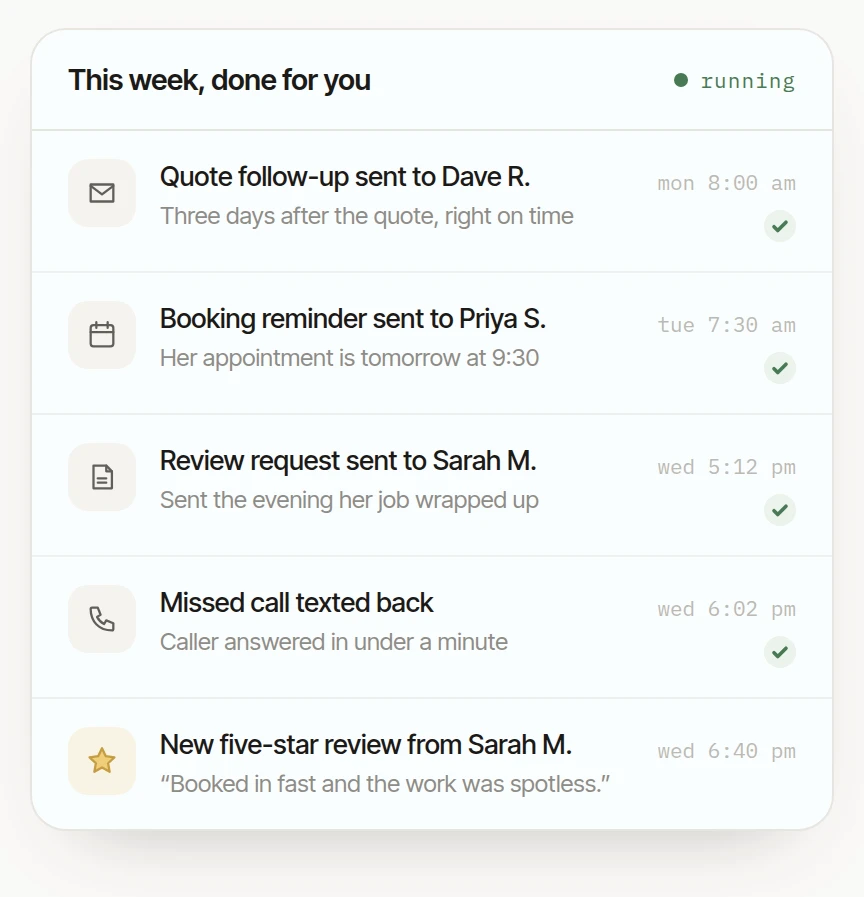
A reply goes out within seconds acknowledging the enquiry, confirming the property, and asking the two or three things an agent would ask anyway, then it follows up until the buyer replies.
The immediate reply is what holds the buyer. It does not need to be clever, it needs to arrive before the other agency's does, and that is a matter of seconds rather than effort.
The follow up afterwards is where most of the recovered business comes from. Buyers who go quiet routinely re-engage on a second or third message, and almost nobody sends those by hand across a whole database.
It is worth it if enquiries regularly wait more than a few minutes outside office hours, which is nearly every agency that has not specifically solved it.
The alternative most agencies use is a roster, which works while somebody is disciplined about it and stops working the week things get busy, which is the week the enquiries spike.
It does least for a small agency where one person genuinely does answer everything immediately, and those exist. If that is you, this is not for you.
The way to settle it is to measure the current time to first response rather than to argue about it, and that measurement is free.
In real estate the enquiry is usually lost in the first ten minutes, before anybody has decided anything about the property. That is the part worth fixing.
Related reading from us: AI lead follow up for mortgage brokers.
Yes, it says so. Pretending otherwise loses a buyer who was going to inspect, which is worse than a slow reply.
No. It stops the moment the buyer replies or an agent picks the conversation up.
Faster response times on their enquiries, which is the thing they complain about most and hear about from buyers directly.
The agency. Every account, number and message history stays in your name.