
For locksmiths losing the map to a call centre with a virtual address
The lockout is decided on a map in fifteen seconds, and half your competition is a call centre.
A report on your own listing, checked from a grid of points across your area, showing where you never appear.
 By Reece Rainer
spareday, Newcastle NSW
Last updated
13 September 2026
Read time
4 minutes
By Reece Rainer
spareday, Newcastle NSW
Last updated
13 September 2026
Read time
4 minutes
He was able to take our rough ideas, from concept through to reality. The site has provided an influx of new members, helping to keep our club viable.
A passion-driven, good-hearted and reliable service provider with the competency of a genius when it comes to software engineering, AI technology and marketing.
He created a stunning website for us that captures and nurtures leads with an automated email marketing system, which has filled a huge gap in the business and saved a lot of time (and money!).
Locksmithing is close to the purest emergency trade there is. Somebody is standing outside a door they cannot open, on a phone, with no patience and no intention of comparing anybody.
It is also the trade most heavily infested with national lead sellers pretending to be local, which changes what a real local locksmith has to do to be found.
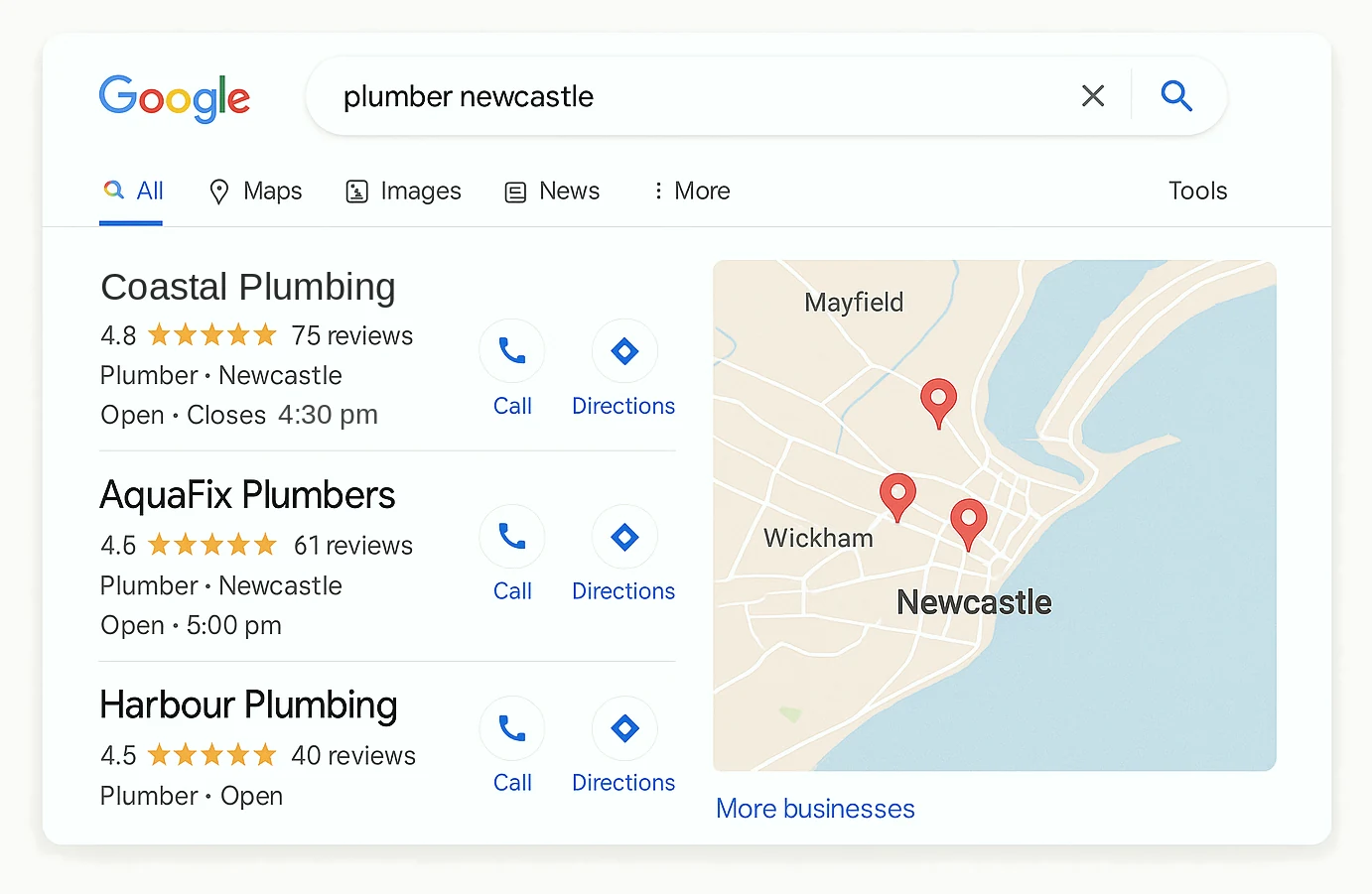
Somebody locked out searches, looks at the map, and rings the top result with reviews that looks close. No website is opened, no comparison happens, and the second call is only made if the first one does not answer.
That makes the Google listing the entire contest for emergency work, not the website. A locksmith with a beautiful site and a thin listing is invisible at the exact moment the trade makes its money.
Answering matters as much as ranking. A missed call in this trade is a customer who has already rung the next locksmith by the time you look at your phone, because they are standing in the cold and cannot wait.
The website's job for this customer is narrow and specific: confirm in one glance that you are real, local and reachable, with a number that dials on tap and a genuine response time.
Locksmithing has more listing fraud than almost any trade. National lead sellers create listings with virtual addresses, rank locally, take the call and sell it on to whoever will pay, often at a price the customer did not expect.
This is why an honest local locksmith can be genuinely good and still invisible. The competition is not another locksmith, it is a system built specifically to occupy the map.
The things that beat it are the things a fake cannot fake: a real verifiable address, a licence number, a real photograph of a real van and a real person, and a body of reviews from people who name the suburb they were locked out in.
Reporting the fakes is also worth the time, because removing one from the map is a permanent rank improvement in a way almost nothing else is. It takes persistence and it works.
Rekeying after a break-in or a tenancy change, restricted key systems, master key systems for a business, safes, access control, door hardware, security upgrades after an insurance assessment. All searched calmly, all worth far more than a lockout.
These customers behave nothing like the emergency one. They compare, they read, they want to understand what a restricted system actually means and why it costs what it costs, and they are often a business rather than a household.
Almost no locksmith website serves them, because the trade's marketing is understandably built around emergencies. That leaves the higher-value half of the trade contested by very few people.
Commercial access control in particular is a long relationship rather than a job, and the search volume is small precisely because the customers are serious. A single page can be worth more than every lockout page combined.
The Google listing first and hardest, then a page for each planned service, a licence number and a real address everywhere, and reviews that name suburbs.
The listing does the emergency work. Correct hours including the ones you actually answer, service area, categories, real photographs, and a steady flow of recent reviews, because recency matters more in this trade than the average rating.
The website does the planned work. One page per service, written for somebody deciding calmly, with enough detail that the price makes sense rather than being defended.
And answer the phone. It sounds too simple to be a strategy, but in a trade where the customer is standing outside their own door, response time is a bigger competitive advantage than ranking one place higher.
The lockout call is won on a map in fifteen seconds. The master key system for an office block is won on a page somebody read at their desk on a Tuesday, and almost no locksmith has written it.
Related reading from us: seo for roofers and seo for automotive.
Weeks for the listing, which is the half that matters most here, and three to six months for the planned-work pages. The listing is where emergency calls are actually decided.
Report them, with evidence, and keep at it. It takes persistence, and it is one of the few things that produces a permanent improvement, because a removed competitor does not come back.
For emergencies, barely. For rekeying, restricted keys, master systems and access control, it is the whole thing, and that is the half of the trade with the margin in it.
It outranks ranking. Somebody locked out rings the next locksmith within a minute, so a missed call is a lost job in a way it simply is not in other trades.