
For businesses who ask for reviews when they remember
Asking every customer is the whole job, and it only happens every time if nobody has to remember.
A report on your own listing, showing how many reviews you gained last year and what the businesses above you gained.
 By Reece Rainer
spareday, Newcastle NSW
Last updated
13 September 2026
Read time
2 minutes
By Reece Rainer
spareday, Newcastle NSW
Last updated
13 September 2026
Read time
2 minutes
Since it went live my phone hasn’t stopped ringing.
He created a stunning website for us that captures and nurtures leads with an automated email marketing system, which has filled a huge gap in the business and saved a lot of time (and money!).
Reece has been generous, reliable and knowledgeable in creating an online presence for our sporting club. He is good to work with and has good technical abilities.
Google review automation solves a problem that is not really about reviews. Most businesses know they should ask, agree to ask, and then ask about one customer in ten.
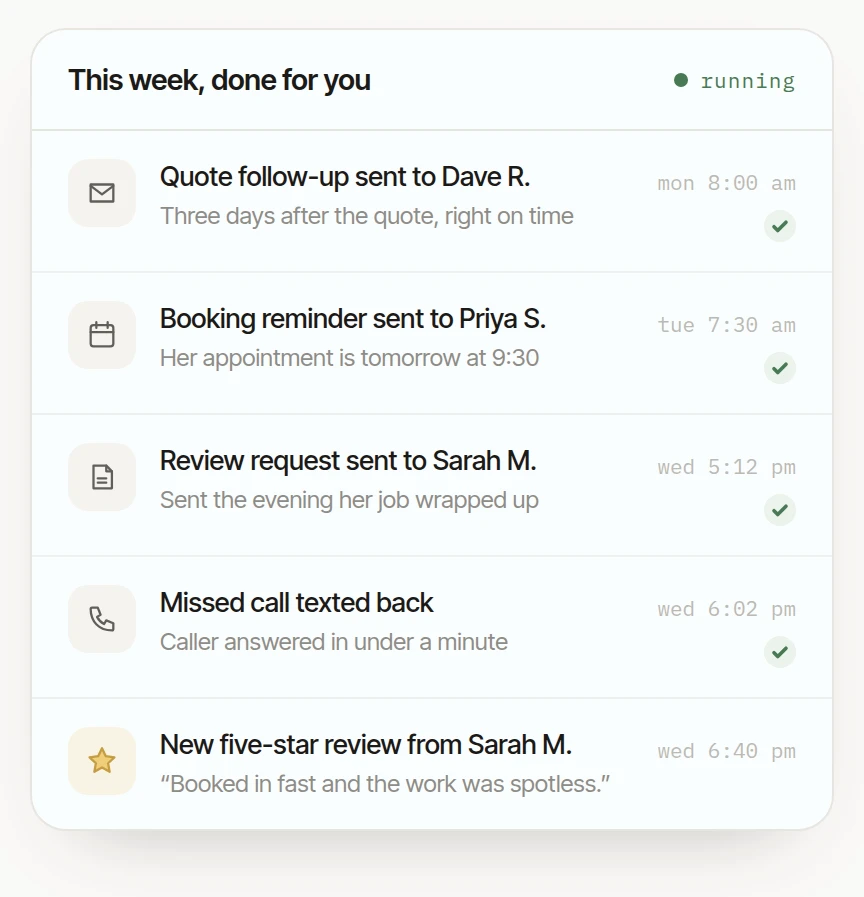
Automating it means the request goes out after every finished job whether anybody thought about it or not, which is the only version that compounds.
Straight after the job is marked finished, by text. Both of those decisions move the reply rate more than the wording does.
Timing wins because the customer still remembers the person who did the work. A request that turns up a week later reaches somebody who has moved on, and a good job has faded into an ordinary one.
Text wins because it gets opened. An email sits in a promotions folder with everything else asking for something. Leaving a review takes two taps on a phone and a lot more at a desk.
Asking only the customers you expect to be happy, and offering anything in return for a review. Google's own rules cover both, and automation makes both easy to switch on without thinking.
Filtering is the common one. Some software asks how the job went and only sends the review link to the people who answer well. That is against Google's rules, and those are the listings that lose their reviews in a sweep.
Offering a discount or a draw entry is the other. It is against the rules too, and the reviews it buys read like it. A customer spots that long before Google does.
Everybody gets asked, nobody gets paid, and a three star turns up now and then. A listing that is nothing but five stars reads as one nobody believes.
Replying. The request can be automatic and the reply cannot, because a reply is read by the next customer deciding whether to ring you.
A bad review answered plainly is read by the next customer as proof of how a problem gets handled. There is nowhere else on the internet they can see that about your business.
The replies people remember name the job and the fix in two sentences. The ones that read as a template are worse than saying nothing at all.
A business asking every customer for a year ends up with a listing nobody can catch quickly. The asking is the easy part, and it is the part that stops happening the week everyone gets busy.
Related reading from us: Google reviews for tradies.
After every finished job. A set schedule sends requests to people who bought nothing that week, which reads as spam and gets ignored.
Text gets opened and leads to more reviews. Email suits businesses whose customers never gave a mobile number, and it is the second choice rather than the first.
No. Filtering who gets the link is against Google's rules, and listings doing it are the ones that lose a pile of reviews at once.
No. It breaches the rules and the reviews read like it. Asking everybody, every time, works better and carries no risk.
One monthly fee covering everything, month to month, with no lock-in contract. What it comes to depends on the business, so the number gets given on the call.