
For pest businesses whose customers would rather not say
Nobody recommends you at a barbecue, and nobody wants to write it down.
A report on your listing, showing where you sit against the other pest businesses nearby on rating, count and recency.
 By Reece Rainer
spareday, Newcastle NSW
Last updated
13 September 2026
Read time
6 minutes
By Reece Rainer
spareday, Newcastle NSW
Last updated
13 September 2026
Read time
6 minutes
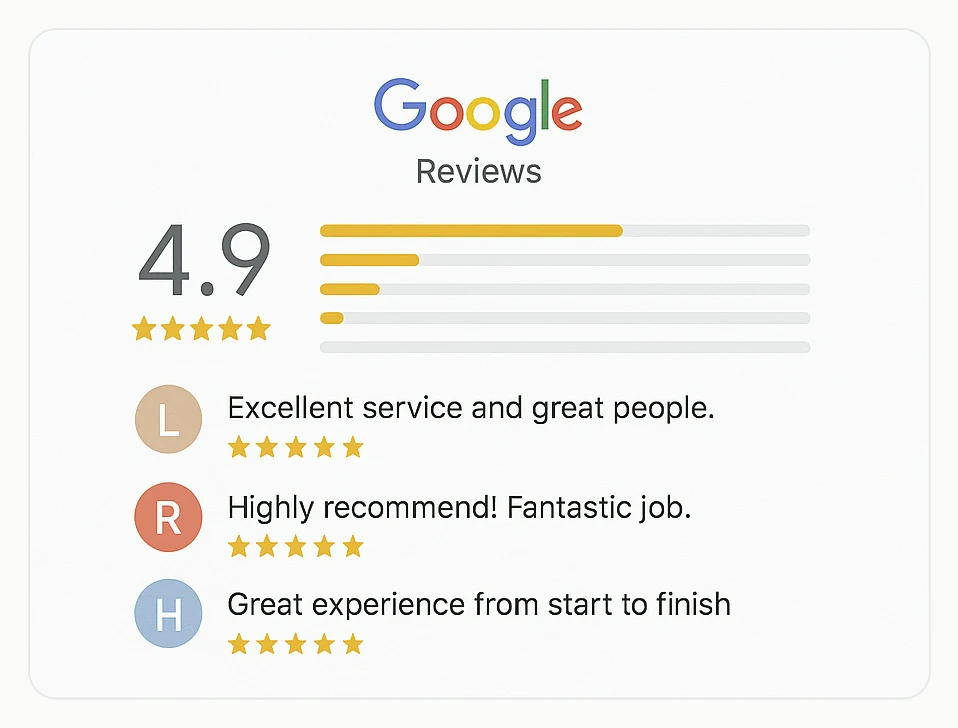
He was able to take our rough ideas, from concept through to reality. The site has provided an influx of new members, helping to keep our club viable.
A passion-driven, good-hearted and reliable service provider with the competency of a genius when it comes to software engineering, AI technology and marketing.
He created a stunning website for us that captures and nurtures leads with an automated email marketing system, which has filled a huge gap in the business and saved a lot of time (and money!).
People do not want anybody to know they needed a pest controller, which makes this the hardest trade in the country to get reviews for and the one where they matter most.
This is why the listing carries the whole decision here, why customers go quiet, and how a pest business gets reviews from people who would rather not admit they called.
Nobody asks a friend for a pest controller recommendation. There is no word of mouth to speak of, because the conversation is embarrassing, so the customer goes straight to the map and decides from what is on the screen.
That makes the profile more decisive in pest control than in any other local trade. In plumbing a good listing supplements a referral network. Here it replaces one that does not exist.
The reader is also in an unusual state. They found something in a cupboard an hour ago, they are unsettled, and they want this dealt with today by somebody who will not make it worse.
What they are reading for is competence and discretion in about equal measure, and the ability to come quickly. Price is checked and rarely decisive.
A review of a pest business is a public statement that the writer had a problem with cockroaches, rats or termites at their address, under their own name. A large share of customers will simply not do it, and they are not being difficult.
This is the real reason pest control profiles are thin, and it gets misdiagnosed as customers being ungrateful. They are grateful. They just do not want it on the internet next to their name.
There are two ways through it and both work. The first is asking about the service rather than the problem, so the customer can write about the technician being on time and thorough without ever naming what was in the roof.
The second is knowing which customers do not have the problem at all. Pre-purchase inspections, annual termite checks, landlords and real estate agents carry no embarrassment whatsoever, and they are the easiest reviews in the trade.
Unlike almost every other trade, the result is not visible when the technician leaves. A treatment works over days or weeks, and a customer asked on the day genuinely does not know yet whether to be pleased.
This changes the timing completely. Asking as the van pulls away gets a review about a polite technician, which is fine but weak. Asking a fortnight later gets a review saying the problem is gone, which is the one that sells.
It also means a two-week follow-up is worth doing for its own sake, review or not. It catches the small number of treatments that did not take, before the customer decides you are useless and says so publicly.
That follow-up is the single highest-value habit in the trade, and it produces the review as a side effect of good service rather than as a marketing task.
A restaurant, a food manufacturer or an aged care facility needs pest control for compliance, with documentation an auditor will read. They are not embarrassed, they are organised, and they will review you if asked.
What they value has nothing to do with what a homeowner values. It is paperwork on time, a technician who does not walk through a kitchen during service, and a report that stands up in an audit.
Those reviews are enormously valuable on a profile because they change what kind of enquiry comes in. Two reviews from food premises make a commercial buyer take the business seriously in a way that fifty domestic reviews cannot.
They also last. A commercial contract is annual and quiet, so the review sits there working for years while the business gets on with it.
A message about a fortnight after a domestic treatment, worded around the service rather than the problem, with a link that opens the review box in one tap, plus a deliberate annual ask of the commercial and preventative clients.
The two weeks is the whole difference. It is late enough for the customer to know it worked, early enough that they remember who did it, and it doubles as the check-in that stops a failed treatment becoming a public complaint.
The wording has to give them a way to write it without naming the problem. Asking how the technician was and whether the visit was on time gives the customer a review they are comfortable putting their name to.
And it has to be automatic, because a pest technician doing six jobs a day is not going to set a reminder for a fortnight's time for each of them.
If you do one thing after reading this, ring three preventative or landlord customers from last month and ask them. Those are the customers with nothing to be embarrassed about, and they are the ones nobody in this trade ever asks.
Related reading from us: Google Reviews For Tradies, work nobody can see, judged on everything else, Local SEO For Pest Control and missed call text back for pest control.
No. It is an incentive under Google's policy and it risks the reviews you already have.
Word the request around the technician and the visit rather than the pest. It gives them something they are comfortable writing under their own name.
About two weeks after the treatment, when the customer actually knows whether it worked.
Ask them directly at renewal rather than automatically. Their reviews are the most valuable on the profile and they change the kind of enquiry you get.