
For networks blaming marketing for a site architecture problem
Your locations compete with each other, and head office is funding both sides.
A report on your location pages, measuring how much of each one is actually unique.
 By Reece Rainer
spareday, Newcastle NSW
Last updated
13 September 2026
Read time
4 minutes
By Reece Rainer
spareday, Newcastle NSW
Last updated
13 September 2026
Read time
4 minutes
He was able to take our rough ideas, from concept through to reality. The site has provided an influx of new members, helping to keep our club viable.
A passion-driven, good-hearted and reliable service provider with the competency of a genius when it comes to software engineering, AI technology and marketing.
He created a stunning website for us that captures and nurtures leads with an automated email marketing system, which has filled a huge gap in the business and saved a lot of time (and money!).
A franchise network competes with itself more often than it competes with anybody else, and search is where that fight happens most expensively.
The head office wants a consistent brand and the franchisee wants the phone to ring in their own suburb, and almost every network's website architecture quietly favours one at the expense of the other.
When two franchisees in neighbouring suburbs both target the same term, Google picks one. The other's pages exist, cost money to maintain, and send their traffic to a competitor who happens to share their logo.
This is the defining structural problem in franchise SEO and it is almost never described as one. Networks treat weak local performance as a marketing effort problem when it is a site architecture problem.
The usual cause is a single national site with thin location pages generated from a template, which is exactly the pattern Google treats as doorway pages. Twenty near-identical pages with a suburb swapped in do not rank; they dilute.
The fix is unglamorous and it works: fewer, genuinely different location pages, each written from that location's real facts, with clear boundaries about which suburbs each one claims.
Head office wants brand consistency, controlled messaging and national terms. The franchisee wants their own suburb, their own phone number, and their own reviews. These pull in opposite directions on almost every page.
The networks that handle it well split the job cleanly. National pages own the brand and the category terms. Location pages own the suburb, the local phone number, the local Google listing and the local reviews, and are written by or with the person who actually works there.
The ones that handle it badly do the opposite: a national contact form for every location, a single phone number, and location pages that are marketing copy with a suburb inserted. The franchisee gets no leads and blames the franchisor, correctly.
There is a third party in this too. Franchise recruitment is its own search, made by somebody considering buying a territory, and it wants completely different content from either of the above.
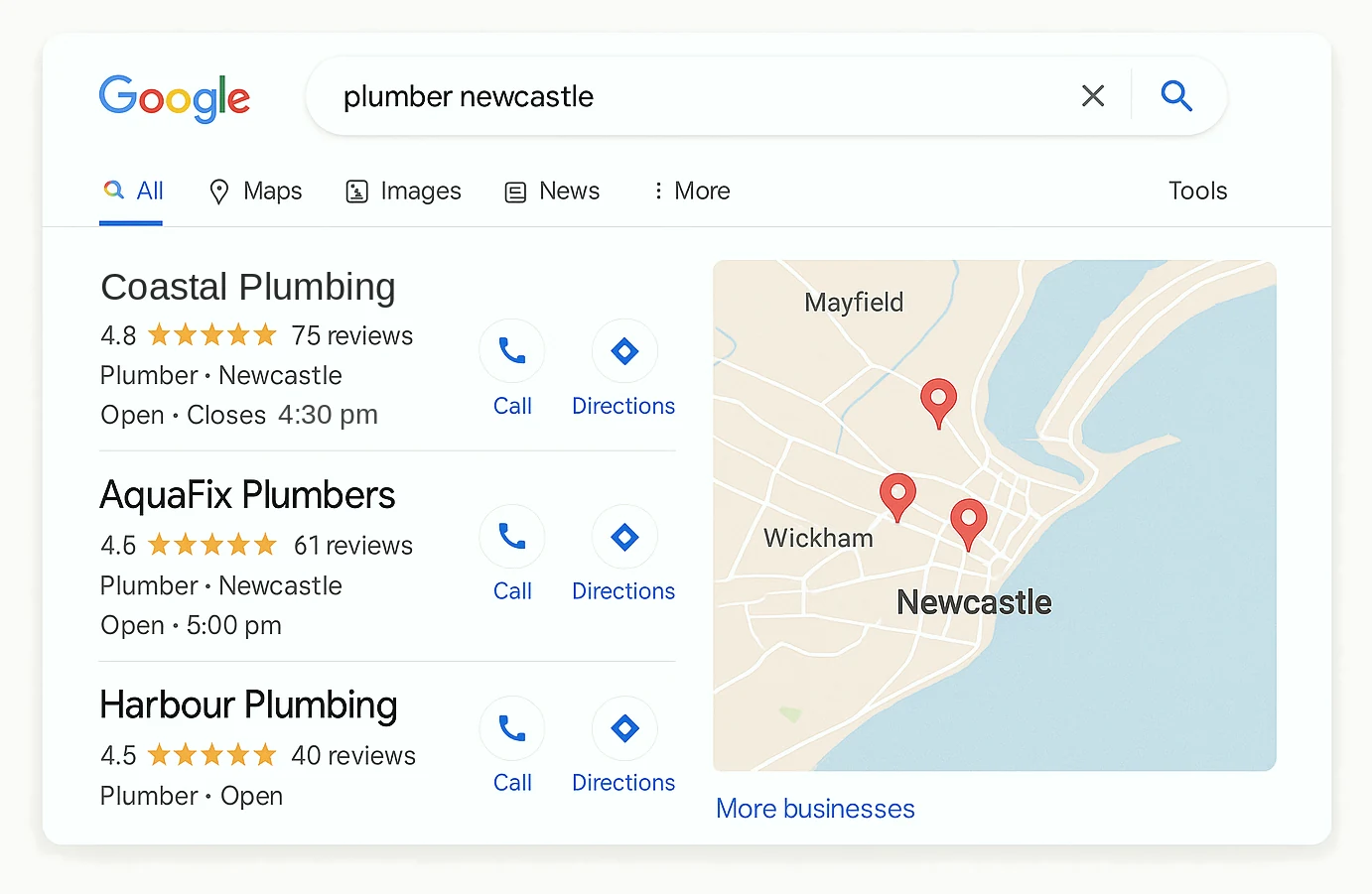
Local search is decided on the map, and a map result needs a real address, real hours, real reviews and a real phone number for that location. A network running one listing for twenty territories is invisible in nineteen of them.
Managing listings at scale is the genuinely hard operational problem in franchising, because the data lives with the franchisee and the standards live with head office. Networks that solve it treat listings as a franchise obligation rather than a marketing extra.
Consistency of the business name across every listing matters more than it sounds. Networks where each franchisee has invented their own variation lose the accumulated signal that a single consistent name builds.
Reviews are the other half and they cannot be centralised. They belong to the location, they are read as being about that location, and a network with three hundred reviews at one site and none at the other nineteen is twenty different competitive positions, not one.
Decide which pages are national and which are local, make every location page genuinely different, give every location its own listing and its own number, and treat franchisee recruitment as separate work.
The location page rule that survives measurement is simple: if a page could have the suburb swapped and still be true, it is not a page. What differs is the team, the local jobs, the parking, the catchment, the hours, and what that area actually asks for.
Then the boundaries. Each location page should state which suburbs it serves, and no two should claim the same ones. That single discipline stops the network bidding against itself and is free to implement.
And the operational half, which is where networks actually win or lose: a process that keeps twenty listings accurate as franchisees come and go, because a listing with the previous owner's hours is worse than no listing at all.
Most franchise networks think they are losing to competitors. Measured properly, a great deal of the loss is one franchisee taking the search from another, funded by head office and blamed on marketing.
Related reading from us: seo for medical clinics and seo for architects.
Weeks for the listings, which is where most of the immediate gain is, and three to six months for the location pages. The listings are usually the bigger and faster win.
Rarely. Separate sites fragment the brand and the authority. Separate location PAGES with their own listings and numbers get the local result without splitting the network.
Usually because they are near-identical. If a page would still be true with a different suburb in it, Google treats the whole set as doorway pages and buries the lot.
Head office should own the standard and the access; the franchisee owns the accuracy and the reviews. Networks that leave it entirely to franchisees end up with twenty different business names.