
Free ranking report guide /
What we look at, what comes back, and how to read it.
We check your Google listing and your site against the businesses ranking above you, and send back the fixes in order.
 By Reece Rainer
spareday, Newcastle NSW
Last updated
25 August 2026
Read time
6 minutes
By Reece Rainer
spareday, Newcastle NSW
Last updated
25 August 2026
Read time
6 minutes
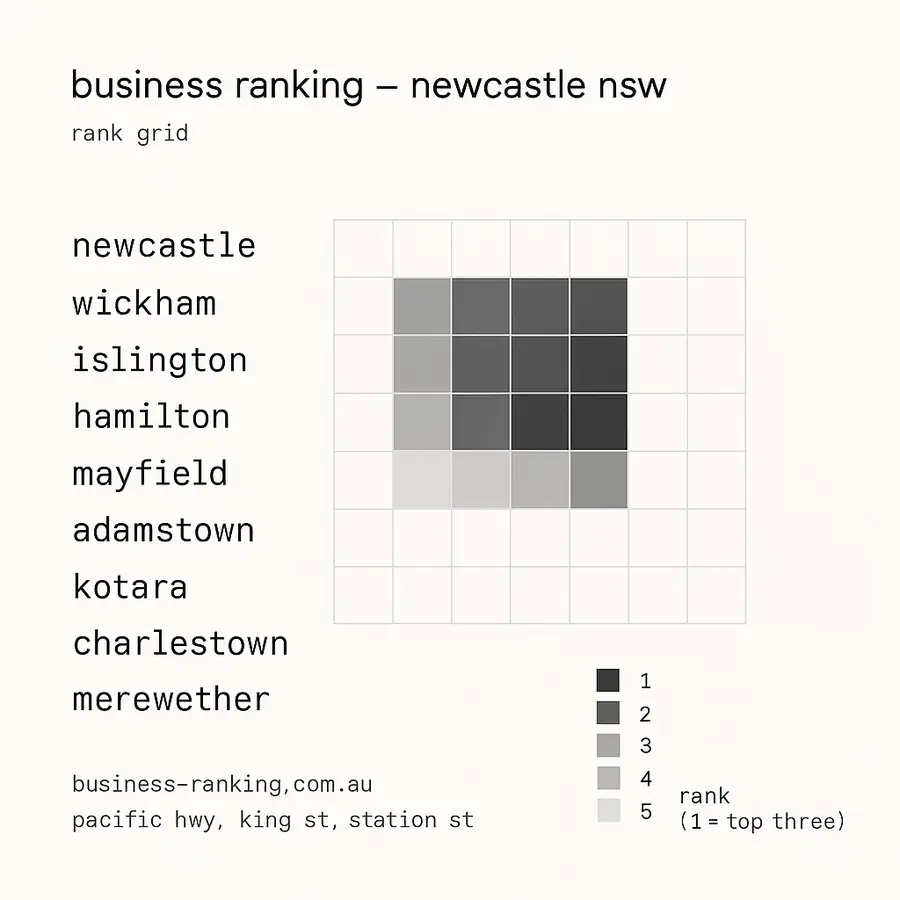
A ranking report is a look at where your business currently stands in Google against the businesses ranking above you, and a list of what is causing the gap.
We run them free for Newcastle businesses. They take us a couple of hours and they are the only honest way to say anything useful about one particular business. What follows is what we look at, what comes back, and how to read it.
Where you rank across the suburbs you care about, what your Google listing is missing, what your website has and has not got a page for, and the same three for the businesses above you.
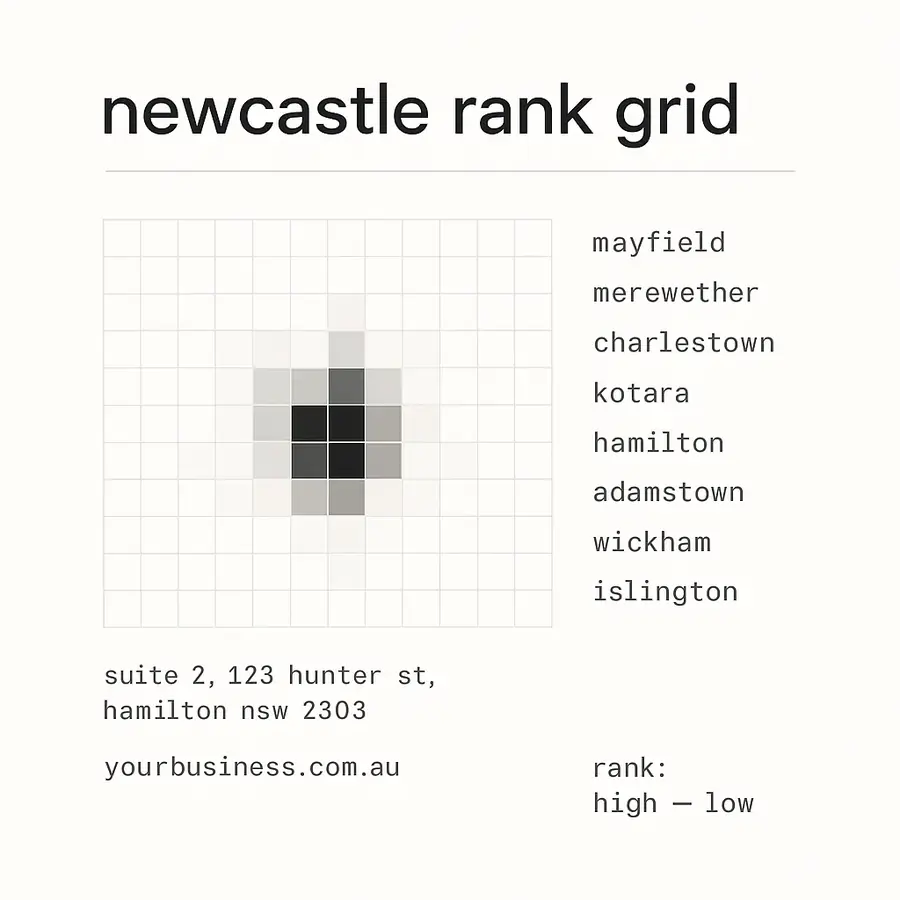
It is four things, and each one is a comparison rather than a score. A number on its own tells a business nothing without the businesses beating it beside it.
The listing side of the report is measured against Google's own guidelines for representing your business.
A short document with the grid, the gaps, and the fixes in the order that moves you fastest. Written so it is useful whether we ever speak again or not.
The document is short on purpose. A long report is easy to produce and hard to act on, and the point of this one is that somebody can start on Monday.
The list is yours to hand to anybody. Plenty of Newcastle businesses work through it themselves, and some hand it to whoever already does their marketing.
Because we cannot say anything useful about a business without looking, and because the businesses worth working with are the ones who read the list and start on it.
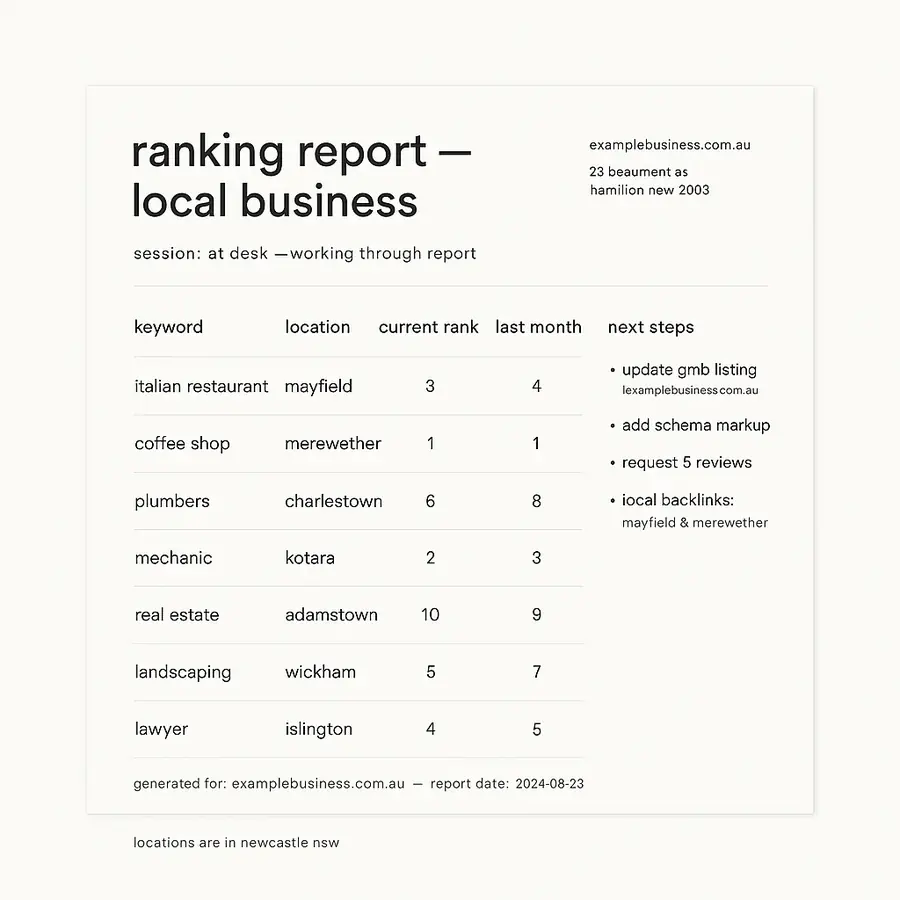
Every marketing conversation starts the same way: somebody describes their business and somebody else describes a package. Neither has looked at anything.
The report replaces that with evidence, which is better for both sides. It takes us a couple of hours, and it means the first conversation is about a specific list rather than about what we generally do.
It also sorts out who we are a good fit for. A business that reads the list and starts on the free half is a business we can help. One that wanted a number quickly is better served somewhere else, and finding that out early suits everybody.
Look at the grid first, then the free fixes, then the gaps against the businesses above you. Start with anything that costs time rather than money.
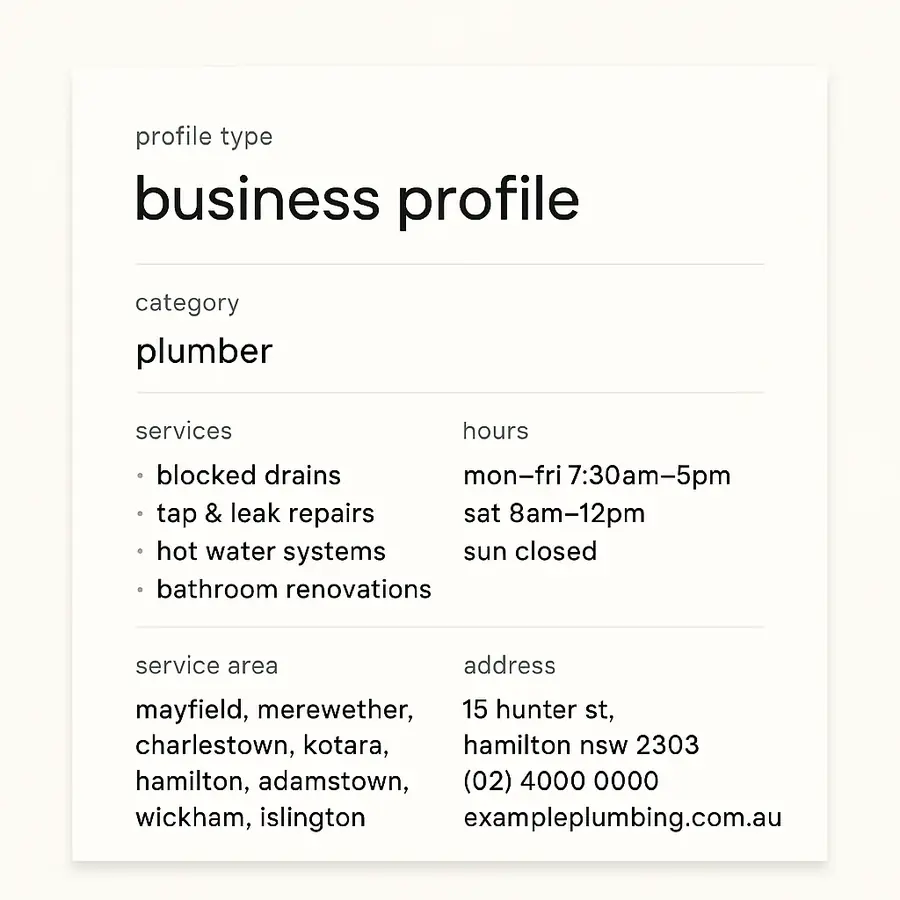
It shows where you already hold and where you drop off. The edge of the green is the reachable part and it is where the work should go.
Categories, the service list, photographs, hours, and asking every customer for a review. An afternoon, and it moves the map.
Specifically. What they have that you do not is usually a short list and it is usually unsurprising once it is written down.
One page per thing. This is the largest piece of work on most lists and it is the one that pays off longest.
Test your own form from a phone. A broken form makes every other fix on the list worth less.
With a specific list in front of you rather than a proposal. That is the conversation we would rather have.
A couple of days to come back to you. The fixes on it run on their own timelines: the listing moves quickly, pages and reviews are the slow half.
The report is a picture of one moment. If you act on it, it is worth running again on the same points later, because two grids months apart is the only honest measure of whether anything worked.
A Newcastle business that shows up for its own name and not much else, or one already paying for marketing and unsure what it is getting. It is less useful for a business with no website yet.
It is worth being straight about who gets something out of this, because a report that tells a business what it already knew is a waste of everybody's time.
If you do not have a website yet, the report has less to look at. The listing half still applies and it is worth doing on its own.
What we need from you, what happens to your details, who else sees it, and what happens afterwards. Short answers to all four.
These are the questions we get asked before people send their details, so they are answered here rather than on a call.
If you would rather just have the conversation, the phone number below reaches us directly.
The most common reaction to one of these is surprise at the grid, because a business that believed it ranked well usually ranks well within a few streets of its own address. That one picture is worth the couple of hours on its own.
Your business name and the suburbs you want work from. Everything the report looks at is already public.
Not for the report. Everything in it is visible from the outside, which is the point of it.
A few days. It is a couple of hours of real work rather than something generated.
Where you rank suburb by suburb, what your listing is missing, what your website has no page for, and the same three for the businesses ranking above you.
Yes. Plenty of Newcastle businesses work through it themselves or hand it to whoever already does their marketing.
You have the list. Whether we speak again is your call and the list works either way.
Since it went live my phone hasn’t stopped ringing.
He created a stunning website for us that captures and nurtures leads with an automated email marketing system, which has filled a huge gap in the business and saved a lot of time (and money!).
I now have a custom dashboard that lets me track exactly what my competitors are doing, spot viral content trends in real time, and script high-performing content ideas on demand. The difference has been night and day. I’m no longer guessing.
This is one part of what we actually do for people.